Debt Solution
Is Credit Card Balance Conversion a Good Way to Pay Off Debt?
If your credit card balance keeps growing because of the high monthly interest, you may have heard of balance conversion as a way out. It turns your revolving balance into a fixed installment plan at a lower rate. For many people it is a genuinely smart move, but it is not right for everyone. The answer depends on your situation.
This guide explains what balance conversion is, when it is a good idea, and when it is not. Simple language, made for regular working people.
💡 Highlights
- Balance conversion turns your outstanding credit card balance into a fixed-term installment plan.
- It usually comes with a much lower interest rate than the card’s regular revolving rate.
- It is a good choice if you can still pay monthly but the high interest is the problem.
- It gives you a clear end date and a predictable payment, unlike a revolving balance.
- It is not ideal if you are already deeply in default or cannot afford the installments.
- It works best when you stop using the card after converting.
- For several debts across different cards, other options may fit better.
What Is Credit Card Balance Conversion?
Balance conversion is when your bank takes your current credit card balance and turns it into a fixed-term installment loan. Instead of a revolving balance that charges high interest every month, you get a set number of monthly payments, often 3 to 60 months, at a lower, fixed rate.
As Philippine legal guidance explains, this usually comes with a much lower interest rate, often around 12 to 24 percent a year instead of the card’s regular rate of about 36 percent a year, and it waives future penalty fees while keeping your account current. In short, it locks your runaway balance into a predictable plan with a clear finish line.
Why Would Balance Conversion Help Pay Off Debt?
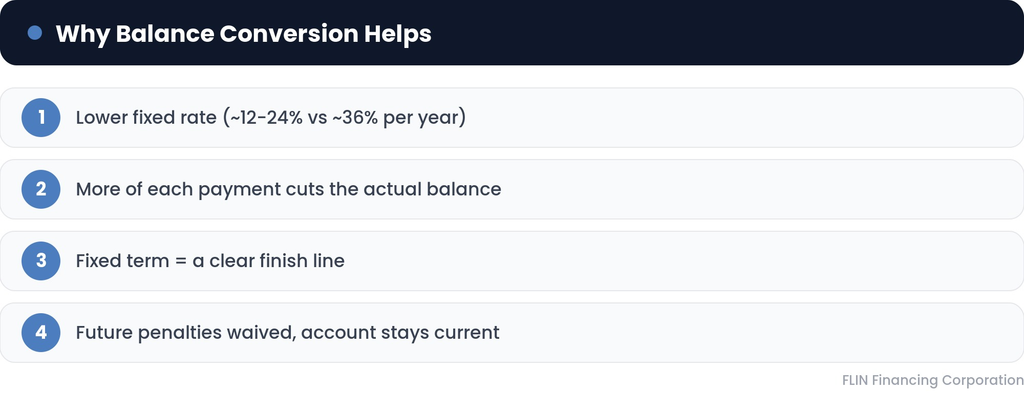
The main reason is the interest. A regular credit card balance in the Philippines can be charged up to 3 percent per month, which is about 36 percent a year, and that interest keeps compounding on whatever you do not pay. This is exactly why carrying a balance feels like it never goes down.
Balance conversion breaks that cycle. By moving to a lower fixed rate, more of each payment goes to the actual amount you borrowed instead of to interest. And because it has a fixed term, you know exactly when the debt will be gone, which a revolving balance never tells you. So for the right person, it can save real money and real time.
When Is Balance Conversion a Good Idea?
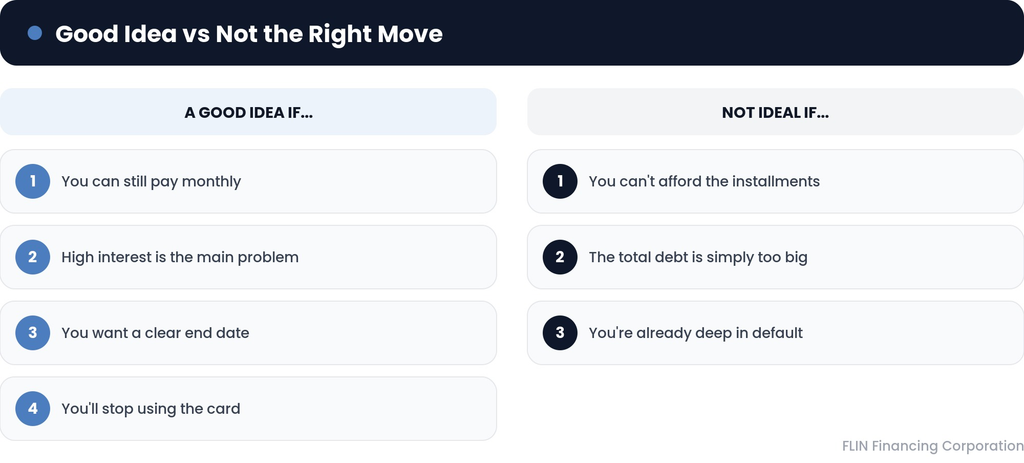
It is a strong choice when a few things are true. You can still afford a monthly payment, but the high revolving interest is what is keeping you stuck. You want a clear, predictable schedule with a definite end date. And you are ready to stop adding new charges to the card.
In this situation, balance conversion is often one of the best moves available. It keeps your account in good standing, protects your credit better than falling behind, and gets you out of the expensive revolving trap. If you have the income to pay but the interest is the enemy, this is usually a smart, low-drama fix.
When Is Balance Conversion Not the Right Move?
Be honest about the limits. Balance conversion is not ideal if you cannot afford even the lower fixed installment, because it still requires steady monthly payments. It also does not reduce the amount you owe, it only reorganizes it, so if your real problem is that the total debt is simply too big for your income, conversion alone will not fix that.
And if you are already deeply in default, a different path like a settlement, where you negotiate to pay less, may fit better. So the key question is whether you can comfortably handle the new monthly payment. If yes, conversion is a great tool. If no, you likely need a different solution.
How Is It Different From Other Options?
It helps to see where balance conversion sits among the choices. Compared to just paying the minimum, conversion is far better, because minimum payments mostly feed the interest while conversion actually pays down the balance. Compared to a balance transfer, which moves your balance to another card at a promo rate, conversion stays with your current bank and gives you a fixed plan. Compared to a settlement, conversion means you pay the full amount on easier terms, while settlement means paying less but hurting your credit more.
If you owe several cards from different banks, you might also look at the Interbank Debt Relief Program, which combines multiple card debts into one plan. Balance conversion is usually best for getting one card’s balance under control.
How Do You Apply for Balance Conversion?
It is simple. Contact your bank, through its hotline, app, or branch, and ask to convert your outstanding balance into an installment plan. Ask about the interest rate, the available terms, and any processing fee. Compare the total cost across the term lengths, not just the monthly payment, since a longer term lowers the monthly amount but can raise the total interest. Once you agree, get the terms in writing, and then avoid using that card so the balance actually goes down.
One note: this article is general information, not legal or financial advice. For your specific situation, it helps to speak with a financial professional.
When One Card Is Just Part of a Bigger Problem
Balance conversion is excellent for taming one card’s high interest. But if your real situation is several debts at once, a couple of cards, some online loans, and maybe a few other balances, converting just one card will not be enough. You need a plan that covers the whole picture.
This is where FLIN PH can help. FLIN helps salaried Filipinos combine high-interest debts, credit cards, online loans, and buy-now-pay-later balances, into one more manageable monthly payment.
In this case, you can do an online consultation with FLIN. So, we’re able to understand and give you some solutions based on your condition. Later, all of your loans will be merged into one new installment with lower interest & longer tenure. You can still manage your life in balance. Let’s start new life with better cash flow, click below for free consultation.
Find out more about how to manage the loan with some great tips below:
Your Debt-Free Life Start Here
Consult with us and get the best solution based on your financial condition
SEC Registered
SEC Registration number : 2026040247321-01