
Debt Solution
How to Be Debt-Free in the Philippines: A Practical Guide for Employees
Being debt-free means you owe no money to anyone, no credit card balance, no loan payments, no utang. For a salaried employee, getting there is not about earning a huge income. It is about managing the income you already have with a clear plan. This guide gives you concrete, step-by-step tips to pay off your debt and stay out of it.
Simple language, made for regular working people.
💡 Highlights
- Being debt-free means you have fully paid off everything you owe.
- Start by listing every debt so you know the exact total you need to clear.
- Pay off your highest-interest debts first, usually online loans and credit cards.
- Build a small emergency fund so a surprise expense does not force you to borrow again.
- Use your 13th month pay and bonuses to knock down debt faster.
- Follow a simple budget rule so your salary covers needs, wants, and debt payments.
- Stop taking new debt while you are clearing the old, or you will never catch up.
What Does Debt-Free Mean?
Debt-free simply means you do not owe money to any lender or person. You have paid off your credit cards, your loans, your installment plans, and any utang, and you are no longer making monthly payments on borrowed money.
It does not mean you never borrowed before. It means you have cleared what you took on. For a salaried employee, being debt-free is a realistic goal, and the tips below show you exactly how to reach it step by step.
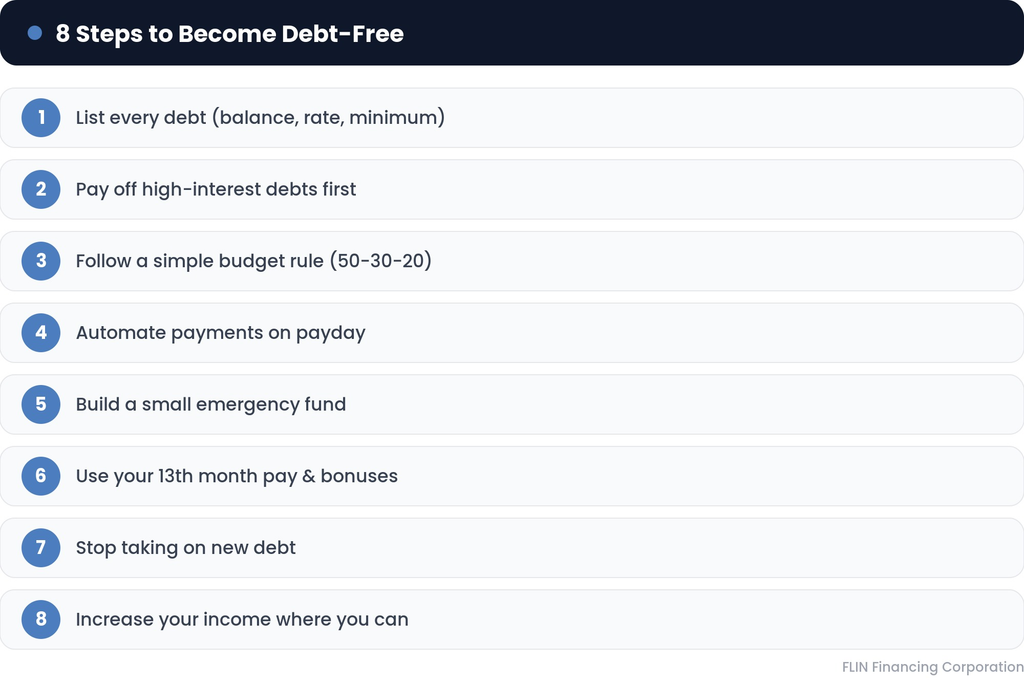
Step 1: List Every Debt You Have
You cannot pay off what you have not measured. So the first step is to write down every single debt in one place. For each one, note three things: the total balance you still owe, the interest rate, and the minimum monthly payment.
Include everything: credit cards, salary loans, SSS or Pag-IBIG loans, online loan apps, appliance installments, paylater balances, and money borrowed from family. Once it is all on one page, you will see your real total and which debts are the most expensive. This is the foundation for your whole plan.
Step 2: Pay Off High-Interest Debts First
Not all debt is equal. The debts with the highest interest rates are draining you the fastest, so those get your attention first. For most Filipinos, that means online loan apps and credit card balances, which carry much higher rates than bank loans or government loans.
Here is the simple method. Keep paying the minimum on every debt so none go into default. Then take every spare peso you can find and throw it at the single most expensive debt until it is gone. Once it is cleared, move all that money to the next most expensive debt. Each debt you finish frees up more cash for the next one, so you pay off faster as you go.
Step 3: Follow a Simple Budget Rule
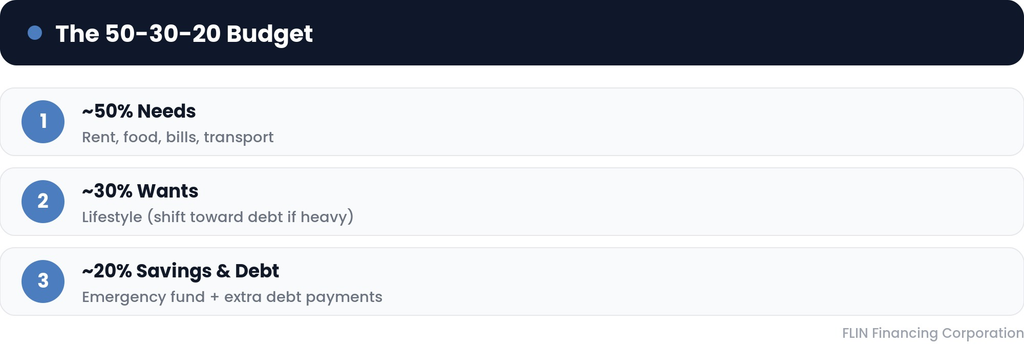
To free up that spare money, you need a budget. A simple one that works for salaried employees is the 50-30-20 guide. Split your take-home pay into three parts: about 50 percent for needs like rent, food, bills, and transport; about 30 percent for wants; and about 20 percent for savings and extra debt payments.
If your debt is heavy, flip more of the “wants” portion toward debt for a while. The point is to give every peso a job before payday arrives, so your money goes where you decide instead of disappearing. Track your spending for one month and you will usually find expenses you can cut.
Step 4: Automate Your Payments on Payday
A fixed salary is an advantage here, so use it. Set your debt payments and savings transfers to happen automatically, right after your sahod lands, before you have a chance to spend it. Pay your debts and your savings first, then live on what is left.
This works far better than trying to save whatever remains at the end of the month, because by then there is usually nothing left. Automating also means you never miss a due date, which keeps you from paying extra penalties.
Step 5: Build a Small Emergency Fund
This step is what keeps you debt-free for good, so do not skip it. Even while paying off debt, set aside a little money for emergencies. Start with a small target, like 20,000 pesos, then build toward three to six months of expenses over time.
The reason is simple. Without a buffer, the next surprise, a hospital bill, a broken phone, a sudden trip home, forces you to borrow again, and you fall right back into the cycle. A small emergency fund breaks that cycle by covering the surprise without a new loan.
Step 6: Use Your 13th Month Pay and Bonuses
As a salaried employee, you have a powerful tool many forget about: your 13th month pay and any bonuses. This is money you do not rely on for daily expenses, which makes it perfect for attacking debt.
Instead of spending your whole 13th month pay, aim a large part of it straight at your most expensive debt. One 13th month pay pointed at the right balance can do what months of small payments cannot. The same goes for performance bonuses, tax refunds, or any windfall. Use them to jump ahead on your payoff.
Step 7: Stop Taking On New Debt
This is the rule that makes everything else work. You cannot get out of a hole while you keep digging. So while you are clearing your debts, stop taking new ones. No new loan apps, no new installment purchases, and freeze the credit cards you are paying down.
If you feel the urge to borrow for something that is not an emergency, wait and save for it instead. Every new debt you avoid is money that goes to clearing the old debt faster.
Step 8: Increase Your Income Where You Can
Paying off debt is faster when more money comes in. If you have the time and energy, even a small side income helps, such as a weekend raket, freelance work, or selling things you no longer use. Send every extra peso straight to your debt, not to new spending.
This does not have to be forever. Treat it as a push for a few months to clear your debt faster, then you can ease off once you are free.
How Do You Stay Debt-Free After Paying Off?
Clearing your debt is only half the job. Staying debt-free is the other half, and it comes down to a few habits. Keep your emergency fund topped up so surprises do not send you back to borrowing. Use your credit card only for what you can pay in full each month. Keep following a budget so your spending stays inside your income. And before borrowing for anything, ask if you truly need it and whether you could save for it instead.
One note: this article is general information, not financial advice. For your specific situation, it helps to speak with a financial professional.
When Your Debt Is Too Big to Clear Alone
Sometimes you do everything right, but the debt is simply bigger than your salary can handle, with the minimum payments already eating most of your pay. That is not a failure of discipline. It means the debt needs to be reshaped, not just budgeted around.
This is where FLIN PH can help. FLIN helps salaried Filipinos combine high-interest debts, credit cards, online loans, and buy-now-pay-later balances, into one more manageable monthly payment.
This is the best way to get free from debt, while still having enough money to manage your cash flow. It’s a balance way to achieve debt-free life, without taking a new loan again. Click below for free consultation.
Find out more about how to be debt-free via articles below:
Your Debt-Free Life Start Here
Consult with us and get the best solution based on your financial condition
SEC Registered
SEC Registration number : 2026040247321-01