
Debt Consolidation
How Can I Fix My Credit Score After Missing Loan Payments in the Philippines?

Missing loan payments can feel like it permanently ruins your financial future, but it does not. A damaged credit score is not a life sentence. With steady, deliberate steps, you can rebuild it over time, and every on-time payment from here helps. The key is knowing what actually moves the needle and being patient with the process.
This guide explains how to fix your credit score after missed payments. Simple language, made for regular working people.
💡 Highlights
- A low credit score from missed payments is fixable, but it takes time and consistency.
- Your payment history is the single biggest factor, so getting current is step one.
- Bring any overdue accounts up to date, then pay everything on time from now on.
- Keep your credit card balances low, ideally under about 30 percent of your limit.
- Check your credit report for errors and dispute any mistakes you find.
- Avoid applying for lots of new credit while you are rebuilding.
- Even a few months of consistent, on-time payments can start to lift your score.
First, Understand What Hurt Your Score
Before fixing it, it helps to know what happened. In the Philippines, your borrowing and payment history is recorded by the Credit Information Corporation (CIC), the government’s credit registry. When you miss payments, those delinquencies get reported, and your score drops.
Here is the reassuring part. Your credit history reflects your recent behavior, not just your past mistakes. So while missed payments do leave a mark, a steady stream of good behavior afterward gradually outweighs them. The goal is to start building that positive record now.
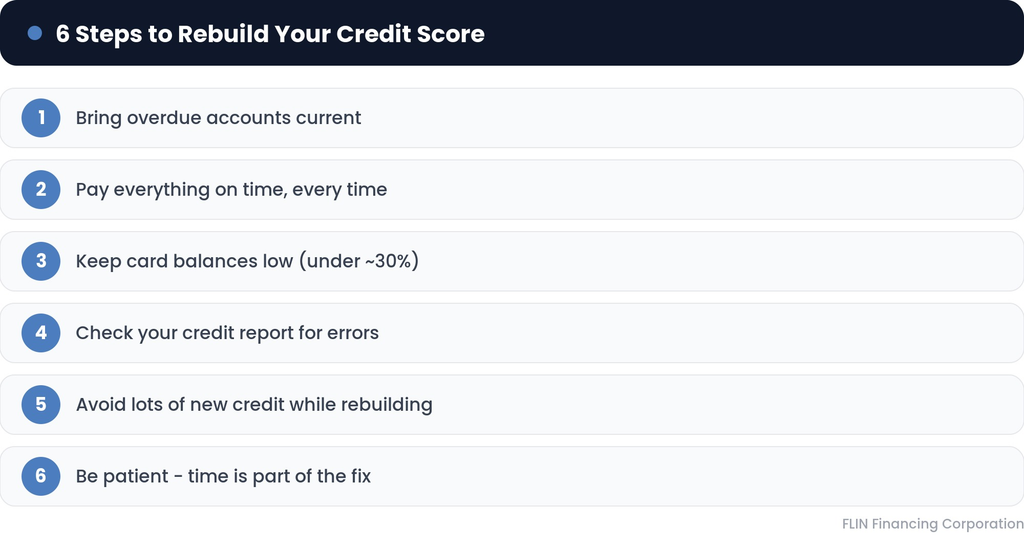
Step 1: Bring Your Overdue Accounts Current
This is the most important first move. As Philippine credit guidance explains, the biggest factor in your score is your payment history. So the fastest way to stop the damage is to catch up on any accounts that are past due.
Focus first on the debts that are overdue, and get them back to current status. If you cannot pay the full overdue amount at once, contact your lender and ask about a catch-up arrangement or restructuring. Getting your accounts out of delinquency is the foundation for everything that follows.
Step 2: Pay Everything on Time, Every Time
Once you are current, the single most powerful habit is paying on time, always. Each on-time payment is a new positive entry that slowly pushes down the weight of the old missed ones.
Set up reminders or automatic payments so you never miss a due date again. Consistency is what rebuilds trust with lenders, and there is no shortcut around it.
Step 3: Keep Your Credit Card Balances Low
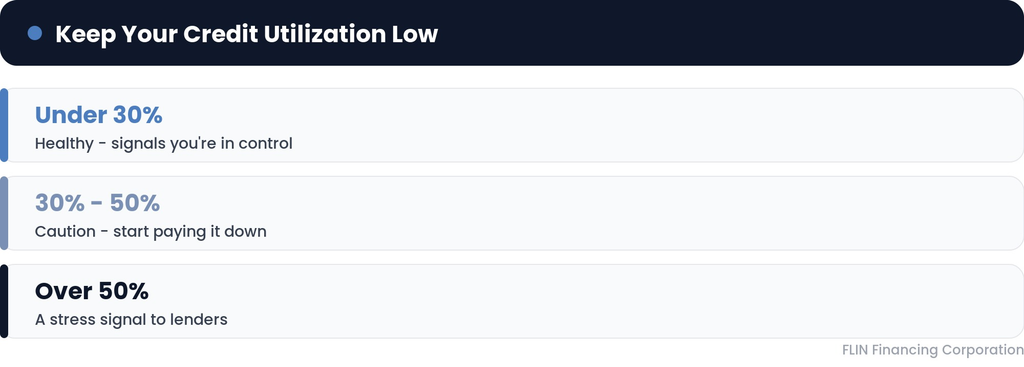
How much of your credit limit you use also affects your score. As a general rule, keep your balances below about 30 percent of your limit. Maxing out your cards signals financial stress to lenders, even if you are paying on time. So paying down your card balances, not just meeting the minimum, helps your score recover faster.
Step 4: Check Your Credit Report for Errors
Sometimes your score is lower than it should be because of a mistake, not your own missed payments. So get a copy of your credit report and review it carefully. If you find an account that is not yours, a payment marked late that you actually paid on time, or a balance that is wrong, dispute it. The CIC has a process to correct errors, so fixing a mistake can give your score a lift you deserve.
Step 5: Avoid Taking On Lots of New Credit
While you are rebuilding, resist the urge to apply for many new loans or cards. Each application can make lenders more cautious, and taking on new debt while you are recovering only adds pressure. Focus on managing what you already have well. If you are building credit from a thin file, using one small, manageable loan or a secured card and repaying it faithfully can slowly build a positive record, but keep it limited and deliberate.
Step 6: Be Patient, Because Time Is Part of the Fix
This is the honest truth. Credit scores do not jump back overnight. Rebuilding is a gradual process, and the longer you maintain good habits, the more your score recovers. The missed payments fade in importance as newer, positive history piles up. So treat this as a marathon, not a sprint, and trust that steady effort pays off month after month.
One thing for sure, if you are seeking help for your overflown debt, FLIN is here to help you. We can help you by merging all of your loans into one.
Our solutions also offer tenure up to 36 months with reasonable interest. Thus, you can manage your money easily, compared to pay many loans with different tenure. Click below for free consultation.
Find out more about how to fix your credit score via articles below :
Your Debt-Free Life Start Here
Consult with us and get the best solution based on your financial condition

SEC Registered
SEC Registration number : 2026040247321-01