Debt Solution
Debt Restructuring in the Philippines, What It Is and How It Works
When loan payments become too heavy to keep up with, debt restructuring is one of the most useful tools available. In simple terms, it means changing the terms of your loan so the payments become manageable again, without erasing the debt. It is a way to keep paying and avoid default, just on easier terms that fit your situation.
This guide explains what debt restructuring is, how it works in the Philippines, and when it makes sense. Simple language, made for regular working people.
💡 Highlights
- Debt restructuring means changing the terms of an existing loan to make repayment easier.
- The debt is not forgiven, it is reworked, so you still owe the money on better terms.
- Common changes include a longer term, a lower interest rate, a payment holiday, or frozen penalties.
- It is different from settlement, where you pay less, and from refinancing, which uses a new loan.
- It applies to bank loans, credit cards, and government loans like SSS and Pag-IBIG.
- It is not automatic, so the lender must agree to your proposal.
- Done early, it can prevent default and protect your credit better than simply missing payments.
What Is Debt Restructuring?
Debt restructuring is a change to the original terms of a loan, made so that repayment becomes more manageable for the borrower. As Philippine legal guidance explains, it modifies your loan while still preserving the lender’s ability to recover the debt.
Here is the most important point to understand. Restructuring is not the same as debt forgiveness. The debt remains valid, and you still have to pay it. What changes is how you pay it, by making the terms easier, such as giving you more time or a lower rate. So it is best thought of as reworking a debt you cannot currently manage into one that you can.
How Does Debt Restructuring Work?
The process starts with you asking your lender to change your terms. You explain your situation, usually with proof of income and any hardship, and propose a new arrangement you can actually afford. If the lender agrees, you both sign a new agreement that replaces the old terms, and you begin paying under the new, more manageable schedule.
As Philippine guidance advises, lenders prefer a concrete proposal over vague promises. So instead of saying “I will pay soon,” it is far better to say something like “I can pay 8,000 pesos per month starting next month, with the remaining balance re-amortized over 48 months.” A clear, specific offer is much more likely to be accepted.
What Are the Common Types of Debt Restructuring?
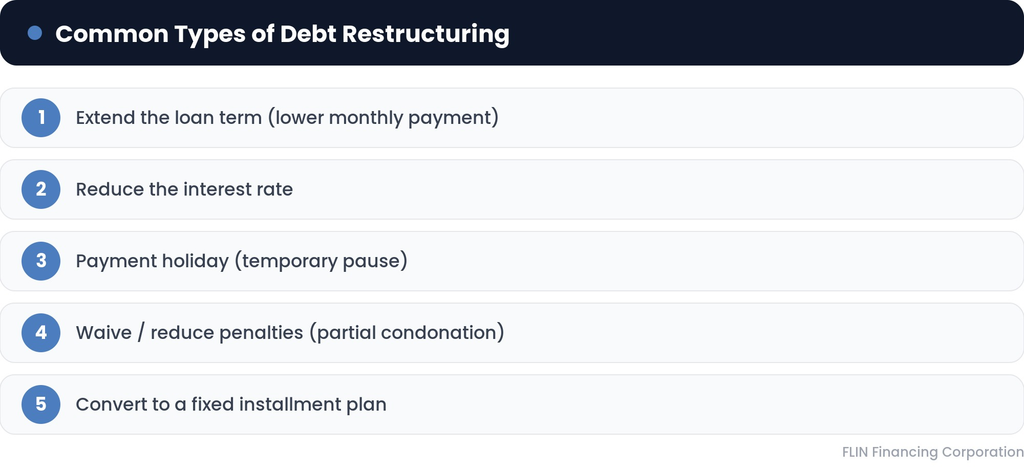
Restructuring can take several shapes, and often combines a few. As Philippine guidance outlines, the common options are:
- Extending the loan term. Stretching the loan over a longer period lowers your monthly payment. This is one of the simplest methods.
- Reducing the interest rate. A lower rate cuts the cost and the monthly amount.
- A payment holiday. A temporary pause or reduction in payments to help you through a rough patch.
- Waiving or reducing penalties. Also called partial condonation, where the lender forgives some of the piled-up charges.
- Converting to a fixed installment plan. Turning a revolving balance, like a credit card, into a predictable fixed-term loan.
Debt Restructuring vs Settlement vs Refinancing
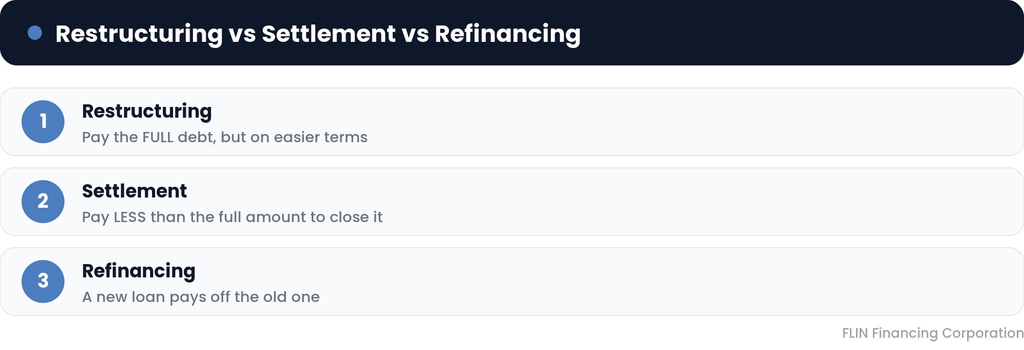
These three get mixed up, so here is the quick difference. As Philippine guidance clarifies:
Restructuring means you still pay the full debt, but on changed, easier terms. It fits people who can keep paying if the terms are more manageable.
Settlement means you pay less than the full amount to close the debt. It fits people who genuinely cannot pay it all.
Refinancing means taking a new loan, often from a different lender, to pay off the old one. Restructuring instead reworks your existing loan with your current lender.
When Does Debt Restructuring Make Sense?
Restructuring is a good fit when you are struggling to keep up, but you could manage the payments if the terms were easier. It is used by both individuals and businesses to prevent default, foreclosure, or legal action. For individuals in the Philippines, it commonly applies to bank personal loans, credit card balances through installment conversion or the Interbank Debt Relief Program, and government loans like SSS, Pag-IBIG, and GSIS, which often run their own restructuring programs.
If your income has dropped or an emergency hit, but you still have some capacity to pay, restructuring is often the smartest first move, because it keeps you out of default.
How Do You Request Debt Restructuring?
Here is a simple approach. First, request a current statement of account from your lender so you know your exact balance. Next, work out what you can realistically pay each month. Then contact your lender’s recovery or restructuring department and submit a written request with a concrete proposal, along with proof of income and any hardship. Finally, read the new agreement carefully, including any restructuring fees, and get everything in writing before you sign.
Act early if you can, since lenders have far more room to help a borrower who reaches out while still trying than one who has already gone silent for months.
Is Debt Restructuring a Legal Right?
No, and this is important to know. As Philippine guidance notes, restructuring is not automatic, and the law does not erase a private debt just because you lost income. The lender has to agree. Legally, a restructuring is a new agreement between you and your lender, recognized under the Civil Code as a change made by mutual consent.
For severe cases, especially businesses, there is a formal court-supervised route under the Financial Rehabilitation and Insolvency Act, but for most individuals, a direct negotiated restructuring with the lender is the practical path.
One note: this article is general information, not legal or financial advice. For a complex situation, free legal help is available from the Public Attorney’s Office if you qualify.
What Are the Pros and What Should You Watch For?
The benefits are real. Restructuring can prevent default and the damage that comes with it, lower your monthly payment so it fits your budget, and stop penalties from piling up. Compared to simply missing payments, it protects your credit standing far better.
A few things to watch, though. Restructuring may come with fees, so factor those in. A longer term lowers the monthly payment but can increase the total interest you pay over time. And restructuring only works if you stop taking on new high-interest debt, since adding more defeats the purpose.
Restructuring Your Debt With FLIN PH
Working out a realistic proposal, approaching your lenders, and getting terms that actually fit your income can be hard to do alone, especially when you owe several creditors and the pressure is already building.
This is where FLIN PH can help. FLIN helps salaried Filipinos combine high-interest debts, credit cards, online loans, and buy-now-pay-later balances, into one more manageable monthly payment. If you find it difficult to solve your debt, then we are ready to help you in solving it. Click below for free consultation.
Find out more about other things to decrease your debts via article below:
Your Debt-Free Life Start Here
Consult with us and get the best solution based on your financial condition
SEC Registered
SEC Registration number : 2026040247321-01