
Finance Tips
Secured Debt, What It Is and How It Works
Secured debt is a loan that is backed by something you own, called collateral. If you do not pay, the lender can take that item to recover their money. A housing loan backed by your house and a car loan backed by your car are the most common examples. Understanding secured debt helps you know what is at risk and how it differs from other loans.
Simple language, made for regular working people.
💡 Highlights
- Secured debt is a loan backed by collateral, an asset the lender can take if you do not pay.
- Common examples are housing loans, car loans, and pawnshop loans.
- Because the lender has security, secured debt usually has lower interest than unsecured debt.
- The main risk is losing the asset, such as your home being foreclosed or your car repossessed.
- Unsecured debt, like credit cards and online loans, has no collateral but higher interest.
- If you fall behind on secured debt, contact the lender early to ask about restructuring.
- Losing the collateral is the biggest reason to never ignore a secured debt.
What Is Secured Debt?
Secured debt is a loan that is tied to a specific asset you own. That asset, called collateral, serves as the lender’s guarantee. If you fail to pay, the lender has the legal right to take the collateral and sell it to recover what you owe.
Here is the simple idea. When you take a secured loan, you are promising the lender that if you cannot pay, they can claim a particular item. This lowers the lender’s risk, because they have something to fall back on. That is the defining feature of secured debt: there is always a specific asset on the line.
What Are Examples of Secured Debt?
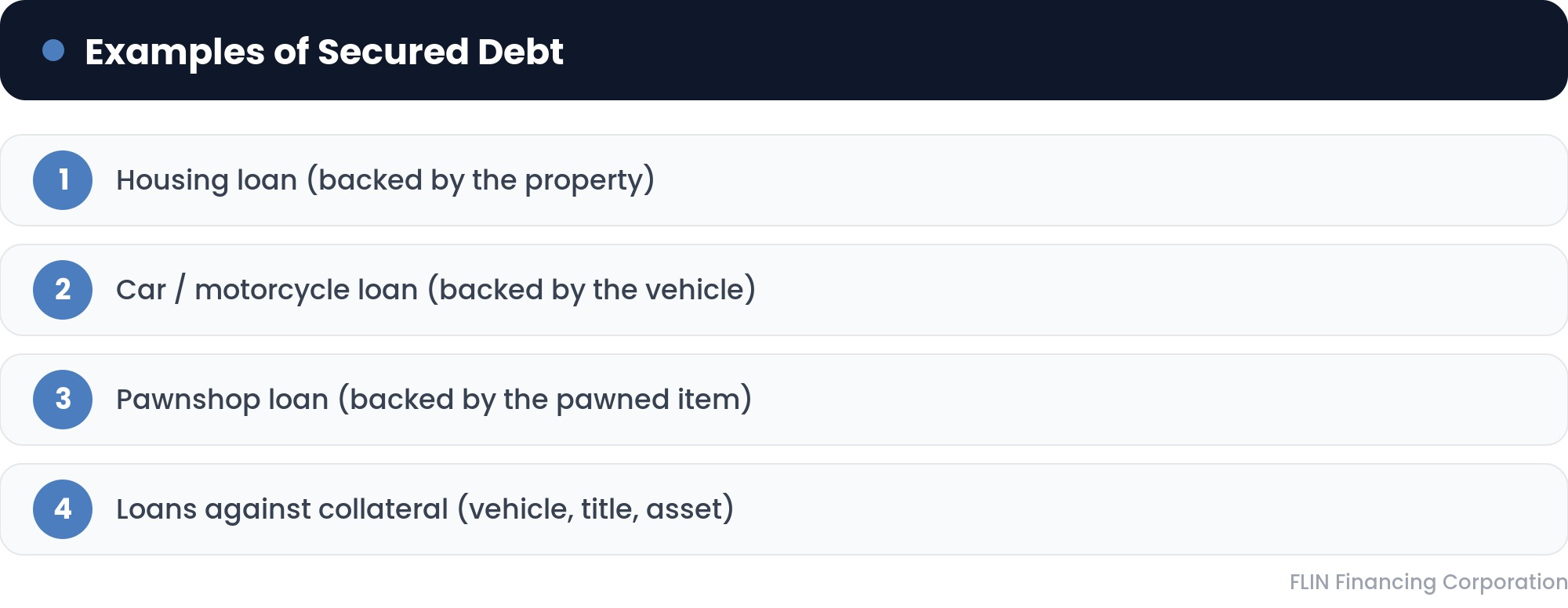
For most Filipinos, the common secured debts are:
- Housing loan. Backed by the house or property you are buying. If you default, the lender can foreclose on the home.
- Car or motorcycle loan. Backed by the vehicle itself. Miss enough payments and the lender can repossess it.
- Pawnshop loan. Backed by the item you pawn, such as jewelry or a gadget. If you do not redeem it, the pawnshop keeps and sells it.
- Loans against collateral. Some loans let you use a vehicle, property title, or other asset to borrow funds.
In each case, the loan is attached to a specific thing you own, and that thing is at risk if you stop paying.
How Is Secured Debt Different From Unsecured Debt?
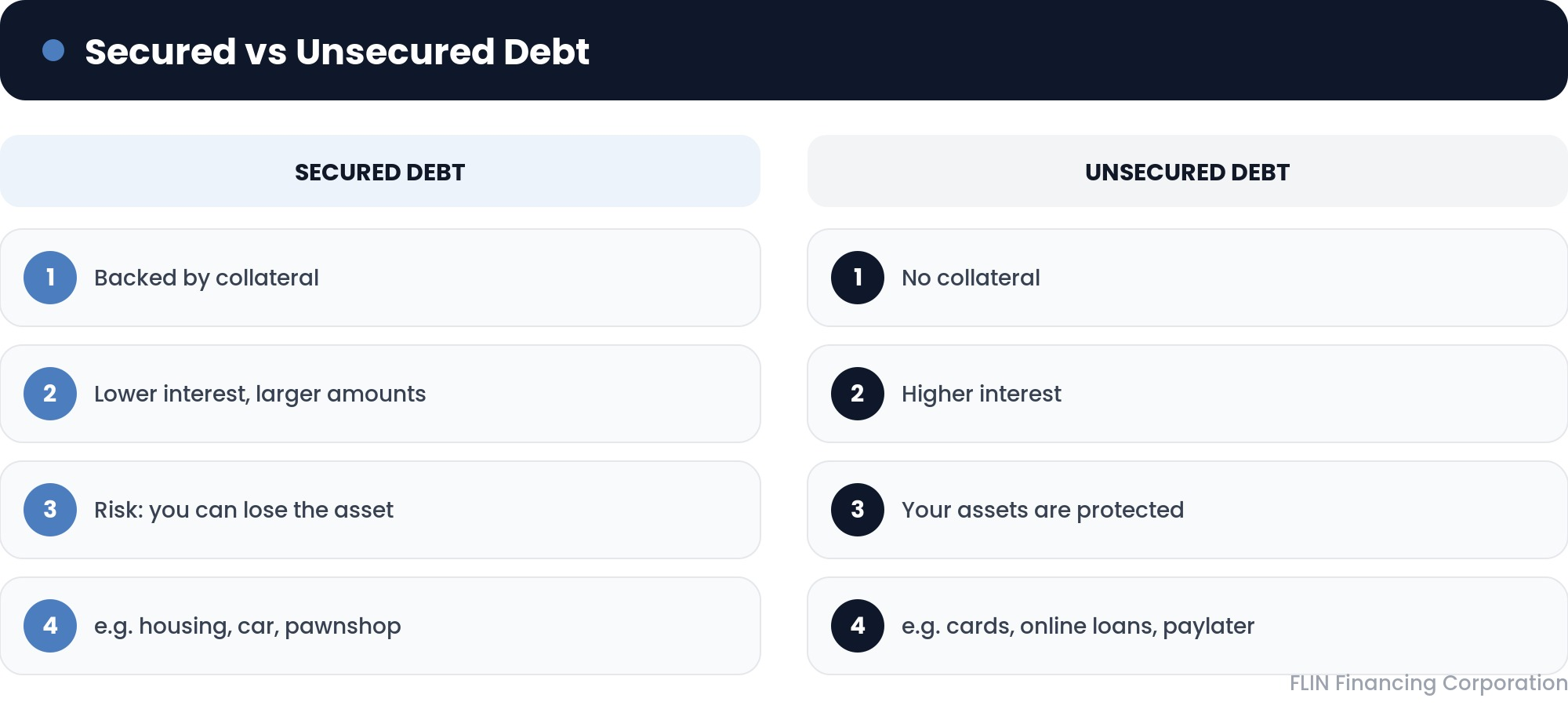
This is the key comparison, and it is simple. Secured debt is backed by collateral, while unsecured debt is not.
With secured debt, the lender can take a specific asset if you default, so their risk is lower, which usually means lower interest and larger loan amounts. A housing loan is a good example, with low rates and long terms.
With unsecured debt, there is no collateral. The lender relies only on your promise to pay and your income. Because their risk is higher, the interest is usually higher too. Credit cards, personal loans, and online loan apps are unsecured.
So the trade-off is this. Secured debt is cheaper but puts an asset at risk. Unsecured debt protects your assets but costs more.
Why Is Secured Debt Usually Cheaper?
It comes down to risk. When a lender has collateral, they know that even if you cannot pay, they can recover most of their money by taking and selling the asset. Because their risk is low, they charge less interest.
This is why a housing loan or a car loan has a much lower rate than a credit card or an online loan. You are essentially trading the security of an asset for a cheaper loan. That lower cost is the upside of secured debt.
What Is the Biggest Risk of Secured Debt?
The biggest risk is clear: you can lose the asset. If you default on a housing loan, your home can be foreclosed, which means the lender takes it to recover the debt. If you default on a car loan, the vehicle can be repossessed.
This is what makes secured debt different to handle than unsecured debt. With an unpaid credit card, there is no specific item the lender can grab without a court process. With secured debt, the asset is on the line from day one. So while secured debt is cheaper, falling behind has a more immediate and concrete cost, losing the thing the loan is attached to.
What Should You Do if You Fall Behind on Secured Debt?
Act early, because the stakes are high. The moment you know you will struggle to pay, contact the lender before you default. Lenders often prefer to work something out rather than go through the trouble of foreclosure or repossession.
Ask about your options. Many lenders offer restructuring, where they rework your loan into easier terms, such as a longer period or lower monthly payment. Government housing lenders like Pag-IBIG also run restructuring and penalty condonation programs from time to time. Explain your situation honestly, show proof of income and hardship, and get any new arrangement in writing. The goal is to keep your asset and get back on track.
One note: this article is general information, not legal or financial advice. For a serious case, especially a home facing foreclosure, free legal help is available from the Public Attorney’s Office if you qualify.
Where to Get Help With Secured and Unsecured Debt
How you get help depends on the type of debt. For secured debt, like a housing or car loan, the best path is to work directly with that lender on restructuring, since the loan is tied to a specific asset that only they can adjust. Reach out to them early to protect your home or vehicle.
For unsecured debt, though, there is more you can do to simplify things. If you are also juggling credit cards, online loans, and buy-now-pay-later balances, that is where FLIN PH can help. FLIN helps salaried Filipinos combine high-interest unsecured debts, credit cards, online loans, and paylater balances, into one more manageable monthly payment.
Note that FLIN focuses on unsecured debt, not secured loans like housing or car loans, so a secured debt stays with its original lender while FLIN helps bring your unsecured debts under control. A short, no-pressure consultation with FLIN PH is enough to see what fits your situation. Knowing which debt is secured and which is unsecured is the first step to handling each one the right way.
Read below to understand about how to be debt-free by clicking below
Your Debt-Free Life Start Here
Consult with us and get the best solution based on your financial condition
SEC Registered
SEC Registration number : 2026040247321-01