Finance Tips
How to Find a Legit, Low-Interest Loan App in the Philippines (Without Getting Scammed)
Searching for a “legit” or “low interest” loan app is smart, because the app store is full of lookalikes, and some of them are illegal or outright scams. The problem is that a polished app with thousands of downloads can still be a predator. So instead of trusting a random “best apps” list, the safer skill is learning how to judge any loan app yourself.
This guide shows you how to tell if a loan app is legitimate, what “low interest” actually means by law, and how to avoid getting scammed. Simple language, made for regular working people.
💡 Highlights
- A legit loan app must be run by an SEC-registered company with a Certificate of Authority.
- For small short-term loans, the law caps nominal interest at 6 percent per month, with penalties capped at 5 percent per month.
- The total of all interest, fees, and penalties can never legally exceed 100 percent of what you borrowed.
- Always compare the effective rate, which includes fees, not just the advertised “0 percent” or headline number.
- The biggest scam sign is being asked to pay a fee before your loan is released. Real lenders never do this.
- Fast approval does not mean safe, so verify the app before you borrow, not after.
- Getting the money through GCash is normal, but what matters is whether the lender itself is legal.
What Counts as a “Low Interest” Loan App?
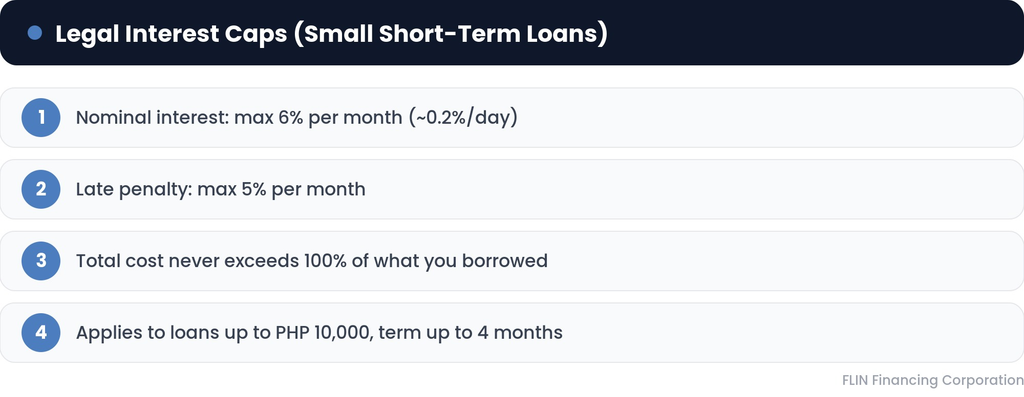
Before you can spot a low-interest app, you need to know what the law allows, so you have a benchmark. As Philippine legal guidance explains, for small, short-term loans, meaning unsecured loans of 10,000 pesos or less with a term of up to 4 months, the rules set clear ceilings:
- Nominal interest is capped at 6 percent per month, which is about 0.2 percent per day.
- Late payment penalties are capped at 5 percent per month.
- Total cost cap: all interest, fees, and penalties combined can never exceed 100 percent of the amount you borrowed, no matter how long it stays unpaid.
There is also an all-in monthly cap that folds in the fees, and this figure was recently updated under new SEC rules that took effect on April 1, 2026, so it is worth checking the current number on the SEC website before you borrow. One important note: these caps apply to small short-term loans. Larger or longer loans have no fixed monthly ceiling, but courts can still strike down unfair rates.
For comparison, a credit card cash advance is capped at 3 percent per month, which is lower than most loan apps. So “low interest” on a loan app is relative. If an app’s real cost is near or above these caps, it is not a low-interest option, and if it is way above them, it is breaking the law.
How Do You Check if a Loan App Is Legit and SEC-Registered?
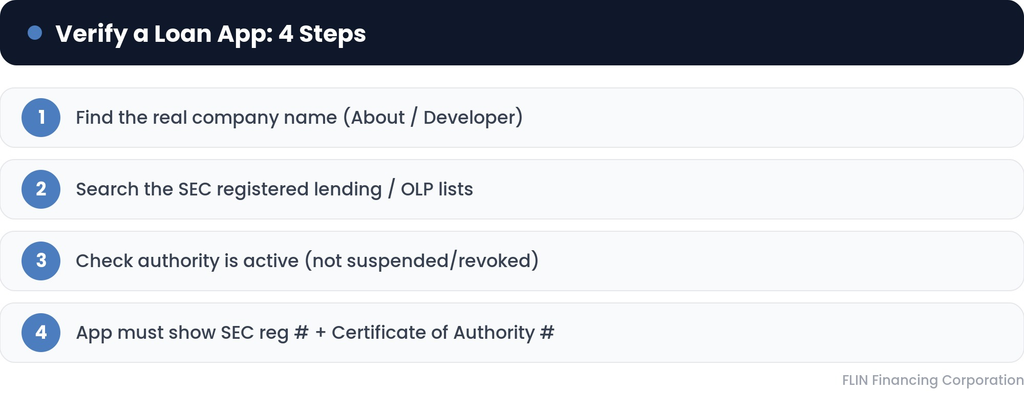
This is the single most important check, and it takes about five minutes. As Philippine legal guidance explains, a legal loan app must be run by a company that is registered with the SEC and holds a valid Certificate of Authority, and the app itself must be registered as an online lending platform.
Here is how to verify it:
- Find the app’s real company name, usually in the “About” section or the app store “Developer” info. The brand name and the legal company name are often different.
- Go to the official SEC website and search the list of registered lending and financing companies, and the list of registered online lending platforms.
- Check that the company appears and that its authority is active, not “Suspended” or “Revoked.”
- Open the app and confirm it clearly shows its SEC registration number and Certificate of Authority number, which legitimate apps are required to display.
If the app is not on the SEC list, or hides these numbers, do not borrow from it.
What Are the Warning Signs of a Scam or Illegal App?
Even some apps on the store are traps, so learn the red flags. The biggest one is being asked to pay an advance fee before your loan is released. As the rule goes, a real lender takes its fees out of the loan, so anyone asking you to send money first, for “processing,” “insurance,” or to “unlock” your loan, is running a scam.
Other warning signs include an app that demands access to your phone contacts or photos, one that does not clearly show the full interest and fees before you borrow, rates that are far above the legal caps, and pressure to decide or install right now. Any of these should make you stop.
How Do You Compare Loan Apps on Cost?
The mistake most people make is trusting the headline rate. An app can advertise “0 percent interest” and still be expensive once you add the processing and service fees. So always look at the effective rate, which folds in all the fees, not just the nominal one.
Two quick habits protect you. First, check the total amount you will repay, including every fee, and compare that across apps. Second, watch for fees deducted upfront, since some apps release less than you borrowed but still charge interest on the full amount. The cheapest app is the one with the lowest real total cost, not the flashiest promo.
What About “Fast Approval” and “Instant Cash” Apps?
Speed is the main selling point of loan apps, but fast does not mean safe. Scammers and illegal lenders rely on urgency, because a rushed borrower does not stop to check. There are legitimate apps that approve quickly, but the speed is not what makes them safe, their SEC registration is. So no matter how urgent your need, run the SEC check first. A five-minute verification is worth far more than a five-minute approval that traps you.
Is It Safe to Get a Loan Disbursed to GCash?
Yes, receiving your loan through GCash or another e-wallet is common and fine on its own. But the payout method is not what makes a loan safe. A scam app can also send money to GCash. What matters is whether the lender behind it is SEC-registered and operating within the legal caps. So judge the lender, not the wallet it pays into.
Should You Even Take a Loan App Loan?
Here is an honest question worth pausing on. If you are hunting for a loan app because you are already struggling with other debts, borrowing more is usually the wrong move, even from a legit, low-interest app. Taking a new loan to cover old ones is how many people fall into a debt cycle, where each new loan makes the total bigger.
So before you borrow, ask yourself whether this loan solves a one-time need, or just patches a hole left by existing debt. If it is the second one, a new app is not the answer.
One note: this article is general information, not legal or financial advice. For a complex situation, free legal help is available from the Public Attorney’s Office if you qualify.
If You Are Borrowing Just to Keep Up With Debt
If the real reason you are looking for another loan app is that your current debts have grown past what your salary can cover, the solution is not a new loan, no matter how legit it is. It is getting the debts you already have under control.
FLIN has a solution that helps you to manage your loan. In this case, debt consolidation that merges all of your loans into new and single installment. This is an efficient plan that can help you in managing cash flow and still paying for your installment. Click below for free consultation!
Find out more about other articles in managing your debts below:
Your Debt-Free Life Start Here
Consult with us and get the best solution based on your financial condition
SEC Registered
SEC Registration number : 2026040247321-01