
Debt Consolidation
Cost of Debt and Other Key Debt Formulas Explained (With Examples)

Whether you are a finance student, a business owner, or an analyst, you will eventually need to calculate how much a company’s debt actually costs and how heavy it is. This guide collects the key debt formulas in one place, the cost of debt, after-tax cost of debt, how it fits into WACC, plus total debt, long-term debt, net debt, and debt service, each with a simple worked example. Clear language, made for anyone learning these.
💡 Highlights
- The cost of debt is the effective rate a company pays on its borrowed money.
- Pre-tax cost of debt = total interest expense divided by total debt.
- After-tax cost of debt = cost of debt multiplied by (1 minus the tax rate).
- Because interest is tax-deductible, the after-tax figure is the one used in WACC.
- Total debt is short-term debt plus long-term debt.
- Net debt is total debt minus cash and cash equivalents.
- Debt service is the total principal plus interest due in a period.
What Is the Cost of Debt Formula?
The cost of debt is the effective interest rate a company pays on its borrowings. As Corporate Finance Institute explains, it is essentially the yield on the company’s debt. The simplest version, the pre-tax or before-tax cost of debt, is:
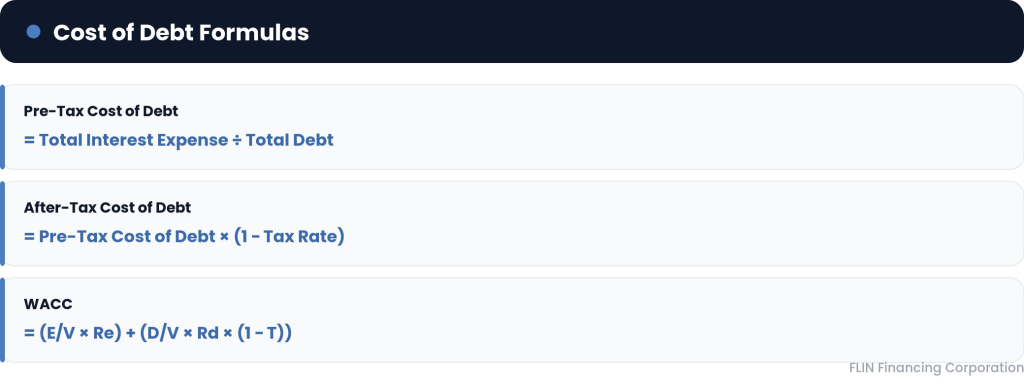
Pre-Tax Cost of Debt = Total Interest Expense ÷ Total Debt
Example: if a company pays 500,000 pesos in interest per year on total debt of 5,000,000 pesos, its pre-tax cost of debt is 500,000 ÷ 5,000,000 = 10 percent.
This tells you what the company pays its creditors before any tax effects are considered.
What Is the After-Tax Cost of Debt Formula?
Here is the part that trips people up. Because interest is usually a tax-deductible expense, borrowing lowers a company’s tax bill, an effect called the tax shield. So the true cost of debt is lower than the headline rate. As Investopedia describes, the after-tax cost of debt is:
After-Tax Cost of Debt = Pre-Tax Cost of Debt × (1 − Tax Rate)
Example: using the 10 percent pre-tax cost of debt above, and a 25 percent corporate tax rate, the after-tax cost of debt is 10% × (1 − 0.25) = 10% × 0.75 = 7.5 percent.
So for every peso of interest, the company saves 25 centavos in taxes, which is why the real cost is only 7.5 percent, not 10 percent.
How Is the Cost of Debt Used in the WACC Formula?
The after-tax cost of debt is one of the main inputs to the Weighted Average Cost of Capital, or WACC, which is the blended cost of all a company’s financing. As Corporate Finance Institute shows, the WACC formula is:
WACC = (E/V × Re) + (D/V × Rd × (1 − T))
Where E is the market value of equity, D is the market value of debt, V is E plus D, Re is the cost of equity, Rd is the pre-tax cost of debt, and T is the tax rate. Notice that the cost of debt enters as Rd × (1 − T), which is the after-tax cost of debt.
Example: if equity is 6 million, debt is 4 million, V is 10 million, cost of equity is 12 percent, pre-tax cost of debt is 10 percent, and the tax rate is 25 percent, then WACC = (6/10 × 12%) + (4/10 × 10% × 0.75) = 7.2% + 3% = 10.2 percent.
What Is the Total Debt Formula?
Total debt is the sum of all a company’s interest-bearing obligations, both short-term and long-term. The formula is:
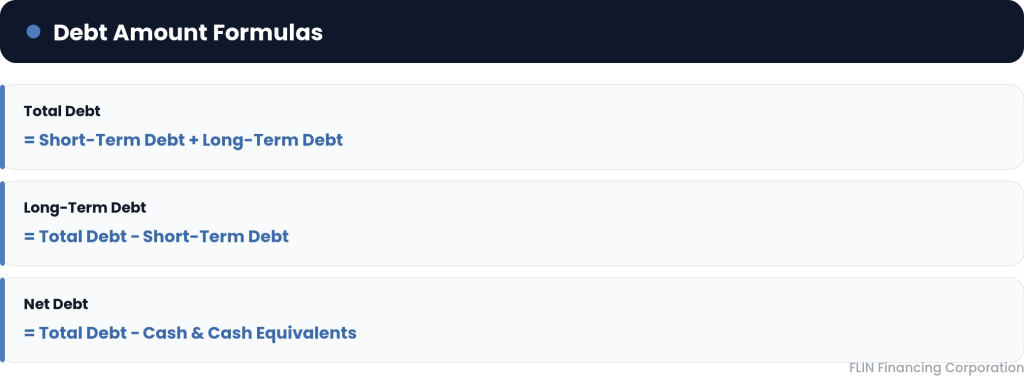
Total Debt = Short-Term Debt + Long-Term Debt
Example: if a company has 1,000,000 pesos in short-term debt and 4,000,000 pesos in long-term debt, its total debt is 5,000,000 pesos.
What Is the Long-Term Debt Formula?
Long-term debt is the portion of a company’s debt that is due beyond 12 months. It is read from the balance sheet, but you can also derive it from total debt:
Long-Term Debt = Total Debt − Short-Term Debt
Example: with total debt of 5,000,000 pesos and short-term debt of 1,000,000 pesos, long-term debt is 4,000,000 pesos.
What Is the Net Debt Formula?
Net debt measures how much debt a company would have left if it used all its available cash to pay debt down. As Investopedia explains, the formula is:
Net Debt = Total Debt − Cash and Cash Equivalents
Example: if total debt is 5,000,000 pesos and the company holds 1,500,000 pesos in cash and equivalents, its net debt is 3,500,000 pesos. A low or negative net debt means the company could clear most or all of its debt with cash on hand.
What Is the Debt Service Formula?
Debt service is the total cash needed to cover debt payments over a period, meaning both the principal and the interest due. The formula is:
Debt Service = Principal Repayments + Interest Payments
Example: if a company must repay 800,000 pesos in principal and 500,000 pesos in interest in a year, its annual debt service is 1,300,000 pesos.
A closely related metric is the Debt Service Coverage Ratio (DSCR), which shows whether income can cover those payments. As Investopedia describes:
DSCR = Net Operating Income ÷ Total Debt Service
Example: with net operating income of 2,000,000 pesos and debt service of 1,300,000 pesos, the DSCR is about 1.54, meaning the company earns 54 percent more than it needs to cover its debt payments.
Quick Reference: All the Debt Formulas in One Place
- Pre-tax cost of debt = Total Interest Expense ÷ Total Debt
- After-tax cost of debt = Pre-Tax Cost of Debt × (1 − Tax Rate)
- WACC = (E/V × Re) + (D/V × Rd × (1 − T))
- Total debt = Short-Term Debt + Long-Term Debt
- Long-term debt = Total Debt − Short-Term Debt
- Net debt = Total Debt − Cash and Cash Equivalents
- Debt service = Principal Repayments + Interest Payments
- DSCR = Net Operating Income ÷ Total Debt Service
These formulas work together to show not just how much a company owes, but how expensive and how manageable that debt really is.
Click below to find out about how to manage your debt and finance wisely:
Your Debt-Free Life Start Here
Consult with us and get the best solution based on your financial condition

SEC Registered
SEC Registration number : 2026040247321-01