
Debt Consolidation
What Is the Interbank Debt Relief Program (IDRP), and How Do You Apply?
If you owe several credit cards from different banks and the payments have become impossible, there is called the Interbank Debt Relief Program, or IDRP, and it can roll your scattered credit card debts into one lower, more manageable payment. Best of all, you can apply for it directly and for free.
This guide explains what the IDRP is, who qualifies, and how to apply step by step. Simple language, made for regular working people.
💡 Highlights
- The IDRP combines your credit card debts from different banks into one restructured plan with a single monthly payment.
- It is run by the Credit Card Association of the Philippines (CCAP) together with the BSP.
- It lowers your interest, stretches your term, and freezes penalties once you enroll.
- It is restructuring, not forgiveness, so you still repay the debt, just on easier terms.
- Eligibility generally requires cards from at least two participating banks, accounts at least six months old, at least ₱10,000 outstanding per card, and at least ₱100,000 in combined credit-card debt
- You apply directly with your bank for free, so you never need to pay an agency to do it.
- It only covers unsecured credit card debt, not housing loans, car loans, or online loan apps.
What Is the Interbank Debt Relief Program?
The IDRP is a credit card debt restructuring program. As the CCAP explains, it is a collaborative effort by the major banks in the Philippines, coordinated through the Credit Card Association of the Philippines together with the Bangko Sentral ng Pilipinas, to help cardholders who are struggling across multiple credit card issuers.
In plain terms, if you owe several banks’ credit cards and cannot keep up, the IDRP lets you combine all of them into one single, more affordable plan. Instead of juggling many due dates and high interest rates from different banks, you get one payment to manage.
What Does the IDRP Actually Do?
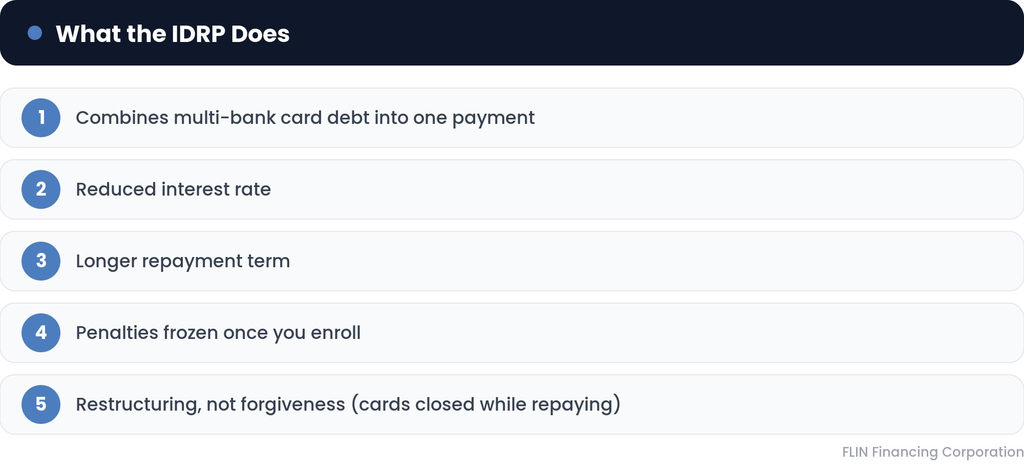
It restructures your combined credit card debt into better terms. As Philippine guidance describes, the program gives you one payment, a reduced interest rate, a longer repayment term, and frozen penalties once you enroll.
One thing to be clear about: the IDRP is restructuring, not forgiveness. Your debt is not erased. It is reorganized so the monthly amount fits what you can afford. There is also a trade-off, which is that your credit cards are closed while you repay under the program, so you lose access to those cards until you finish.
Who Can Apply for the IDRP?
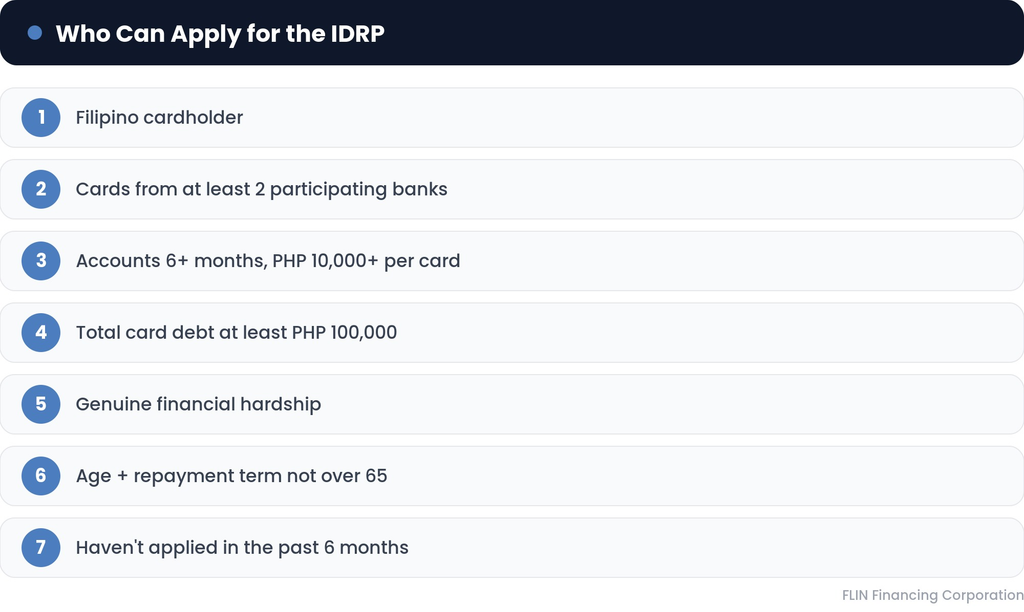
The program has strict rules because it is meant for people genuinely struggling with multi-bank card debt. As the CCAP sets out, the common requirements are:
- You are a Filipino cardholder. Foreigners are generally excluded.
- You have at least one credit card from at least two participating banks, since this is for interbank debt, not a single-card problem.
- Your accounts are at least 6 months old, with at least 10,000 pesos outstanding per card.
- Your total combined credit card debt across all issuers is at least 100,000 pesos.
- You are experiencing genuine financial hardship.
- Your age plus the repayment term does not exceed 65 years.
- You have not applied for the IDRP in the past 6 months.
You also have to declare all your credit card balances. As legal guidance notes, you cannot apply for just one card and hide the rest. Final acceptance is still at the bank’s discretion after you submit the requirements.
What Debts Does the IDRP Cover?
This is important, so you know if it fits. The IDRP only covers unsecured credit card debt. As Philippine guidance clarifies, it does not include housing loans, car loans, or corporate credit cards. It also does not cover online loan app debt. So if your problem is mainly loan apps, or you only owe one bank, the IDRP is likely not the right tool, and you will need a different approach.
How Do You Apply for the IDRP?
The process is simpler than most people expect. As Philippine guidance lays out, here are the steps:
- List all your credit card debts across every bank, with the balances.
- Contact the collections or recovery department of the bank you owe the most to, or any participating bank, and say you want to apply for the IDRP. The CCAP also lists participating banks and their IDRP contact emails.
- Request the IDRP application form and the list of requirements.
- Complete the form, declaring all your credit card balances, and submit your documents.
- The bank evaluates your application, validates your debts through the credit bureau and other banks, and computes your new payment plan.
- If approved, you sign the IDRP Payment Agreement Contract, along with a co-maker if one is required.
- You start paying your single restructured amount, and your cards are closed while you repay.
If your application is denied, you can apply again after 6 months.
What Documents Do You Need?
Prepare these before you apply. As the CCAP and legal guidance list, the usual documents are:
- A completed IDRP application form.
- A valid government ID for you, and for your co-maker if you have one.
- An income and expense statement.
- Proof of income, such as your latest 3 months of payslips, a Certificate of Employment, or your ITR.
- Proof of any other income.
- The signed IDRP Payment Agreement, a debtor’s consent form, and a promissory note or post-dated checks if required.
If you have no income, a co-maker may be required to help pay and sign the agreement.
Do You Need to Pay an Agency to Apply?
No, and this matters. As Philippine guidance stresses, the BSP and CCAP allow you to apply directly with your bank, without needing a “debt settlement” agency. Anyone asking for fees to “negotiate” your IDRP is not necessary, and may be taking advantage of your situation. So apply to your bank yourself and keep your money.
One note: this article is general information, not legal or financial advice. For a complex situation, free legal help is available from the Public Attorney’s Office if you qualify.
What if You Don’t Qualify, or the IDRP Doesn’t Fit?
The IDRP is excellent, but it is narrow. It only helps if your debt is credit cards from at least two participating banks, and you meet its thresholds. Plenty of people fall outside that. Maybe your debt is mostly online loan apps, which the IDRP does not cover. Maybe you only owe one bank. Or maybe your debts are a mix of cards, apps, and other loans.
If that is your situation, you still have options. FLIN helps salaried Filipinos combine high-interest debts, credit cards, online loans, and buy-now-pay-later balances, into one more manageable monthly payment.
Our solution is designed to help everyone in overcoming their debts. What’s special is, our solution is designed based on your financial situation. Thus, this can help you in managing your debt along with cash flow. Click below to do free consultation right now!
Your Debt-Free Life Start Here
Consult with us and get the best solution based on your financial condition
SEC Registered
SEC Registration number : 2026040247321-01