Debt Solution
Unsecured Debt in the Philippines: What It Is and How to Deal With It
Most people never ask themselves this question until they are already buried: what exactly happens when you stop paying your credit card or that online loan? Nobody can take your house. Nobody can repossess your car. So what power do they actually have? That question cuts straight to the core of unsecured debt, the kind most people carry.
💡 Highlights
- Unsecured debt means you borrowed money without pledging collateral like a house or car.
- Credit cards, personal loans, salary loans, and online app loans all count as unsecured debt.
- The lender has nothing to seize, lenders generally charge higher interest rates to compensate for the increased risk.. That is why this debt costs so much.
- If you cannot pay, they cannot just take your stuff. The worst they can do is drag you to civil court over the money.
- You cannot go to jail for unpaid unsecured debt. It is a civil issue, not a criminal one.
- The real danger of unsecured debt is not seizure. It is the high interest quietly stacking up.
- The smartest way out is to go after the highest-interest unsecured debts first, or reshape them through restructuring or consolidation.
What Is Unsecured Debt?
Unsecured debt is any loan you take out without putting up something valuable as a guarantee. No collateral attached. The lender hands you money based mostly on your promise to repay and your earning capacity, not on any asset they can grab if things are not going based on what we want.
Look at it this way. Every time you borrow, the lender assumes a higher level of credit risk.. With unsecured debt, they have no safety net if you default. The entire loan rests on trust. That one fact, the absence of collateral, explains almost everything about how unsecured debt works, including why it costs you more.
What Is the Difference Between Secured and Unsecured Debt?
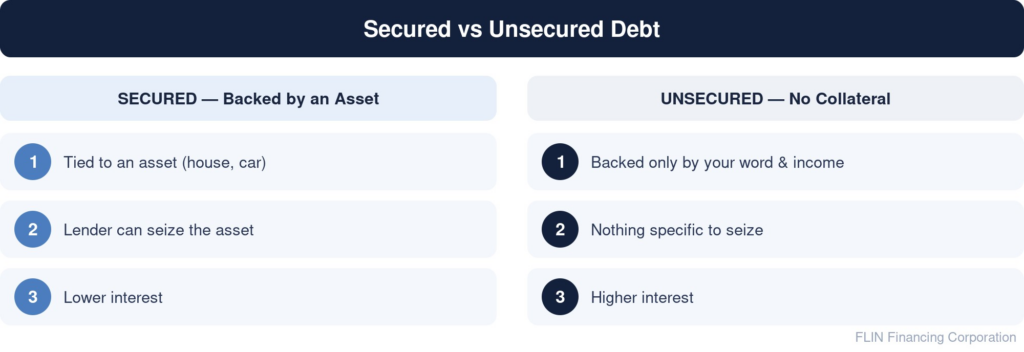
Secured debt has an asset tied to it. A housing loan links to the house. A car loan links to the car. Stop paying, and the lender can take that asset. Their risk stays low, so the interest usually stays low too.
Unsecured debt has nothing backing it except your word and your income. A credit card, a personal loan, an app loan. Stop paying, and there is no specific asset for them to seize. Their risk runs high, so the interest runs high too.
Why Is Unsecured Debt Usually Has Higher Payment?
A lender issuing an unsecured loan knows that recovering money from a defaulting borrower will be slow, messy, and sometimes flat-out impossible. To offset that gamble across all their borrowers, they charge everyone higher interest. You pay extra for the convenience of skipping collateral.
That explains why a credit card balance carried month to month, or an online lending app loan, can drain you far more than a housing loan. The rate is high by design, and that high rate is exactly what makes unsecured debt so easy to fall behind on. The balance keeps growing even while you make payments.
What Are Examples of Unsecured Debt in the Philippines?
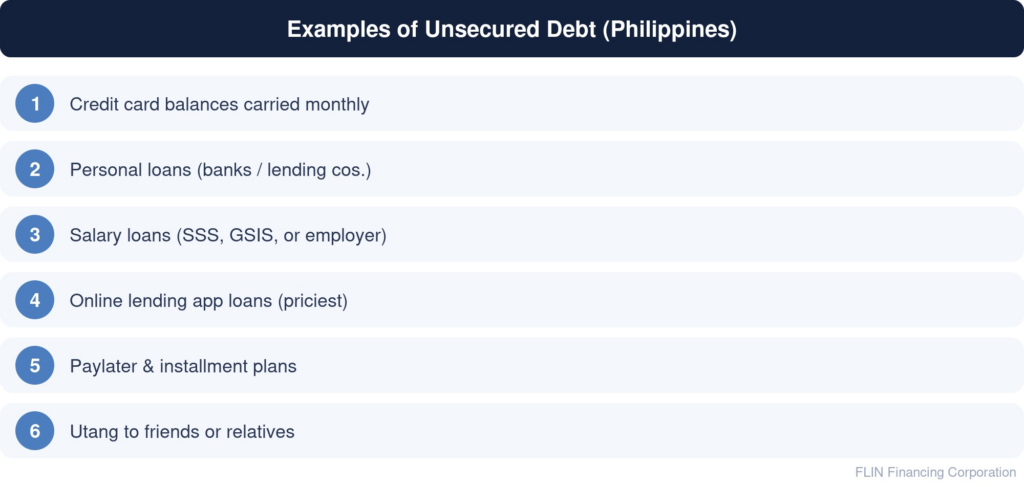
For a typical salaried Filipino, most day-to-day debt is unsecured. Common examples include:
- Credit card balances you carry from month to month.
- Personal loans from banks or lending companies.
- Salary loans, including those from SSS, GSIS, or your employer.
- Online lending app loans, usually the most expensive of the bunch.
- Paylater and installment plans for gadgets or appliances.
- Utang to friends or relatives, informal but still unsecured.
Notice the pattern. These are the loans people grab in a pinch, the fast and easy ones. Unsecured debt is convenient to get, which is exactly why it piles up quietly. Data from the Bangko Sentral ng Pilipinas, compiled by CEIC, shows Filipino household debt hit a record high in 2025, and a big chunk of that pain comes from these easy-to-access, high-interest, unsecured loans.
What Happens If You Cannot Pay Unsecured Debt?
What they can do is this. First, they call and remind you. Then, they usually send a demand letter. If you still do not pay, they can file a civil case in court to try to recover the money. If the court agrees you owe the debt, it issues an order for you to pay, sometimes on a schedule. That is the real process, and no handcuffs appear anywhere in it.
To be very clear, Article III, Section 20 of the 1987 Philippine Constitution states that no person shall be imprisoned for debt. An ordinary unpaid credit card or personal loan is a civil matter, never a crime. Any collector threatening you with arrest over unsecured debt is bluffing.
Can They Take My Salary or My Things for Unsecured Debt?
Only after a long process, and never with just a phone call. A collector cannot freeze your bank account, grab your salary, or seize your belongings on their own.
The only way any of your assets get touched is if the lender first files a civil case, wins it, and secures a court judgment. Even then, the court works through a sheriff and within limits, and the law protects your basic necessities. This stands in stark contrast to secured debt, where a specific asset is already on the line from day one. With unsecured debt, a whole court process sits between a missed payment and anyone touching what you own.
Is Unsecured Debt Worse Than Secured Debt?
Not worse, just dangerous in a different way, and knowing which danger you are facing helps.
Secured debt is dangerous because you can lose the asset. Miss enough car payments and the car disappears. Miss enough housing payments and the home is at risk. The threat is concrete and immediate.
Unsecured debt is dangerous because of the interest. Nothing gets seized, but the high rate lets the balance grow faster than you can pay it, quietly trapping you. The threat moves slower, but it sneaks up on you. For most salaried Filipinos, unsecured debt is the one that actually spirals, precisely because it feels less scary at the moment.
How Do You Get Out of Unsecured Debt?
Here are some things that you need to do:
- First, list every unsecured debt with its balance, interest rate, and minimum payment. Second, keep paying the minimum on all of them so nothing slips into default. Third, take every spare peso you have and throw it at the debt with the highest interest rate, usually an app loan or a carried credit card balance. When that one dies, roll its payment onto the next highest. Each debt you clear frees up more money for the next, so you pick up speed as you go.
- To move faster, aim any windfalls straight at your worst debt. Your 13th month pay and any bonus are the strongest weapons a salaried worker has, because that is money you were not living on anyway.
But if the unsecured debt has grown so large that even the minimum payments outstrip your salary, no budgeting trick will fix it. The problem is the size and shape of the debt itself. At that point, the move is to make the debts become “smaller”, then how to do that?
Debt consolidation is the answer. It’s a service that can help you to combine all of your loans into new installment with lower interest rates and longer tenure. This is a good solution that can help people to pay their loan, which is also offered by FLIN.
Not only the service, FLIN has a great mission to help Filipinos get free from debt. So, with debt consolidation, FLIN tries to educate the client, so they can start a new life with more control on their finances. If you’re facing the same problem, consult with us, we do care about you and have a bright future without any financial problems. Click the button below for free consultation.
For more information regarding how to manage your debt, check below :
Your Debt-Free Life Start Here
Consult with us and get the best solution based on your financial condition
SEC Registered
SEC Registration number : 2026040247321-01