Debt Solution
Debt Instruments: Meaning, Examples, Effect to Finance

Most Filipinos hold at least one debt instrument without ever calling it that. The credit card in your wallet, the salary loan deducted from your payslip, the installment plan on your phone, all of these are debt instruments. Understanding what they are, how they differ, and which ones carry the most risk is one of the quickest ways to get clearer about where your money is actually going every month.
This guide explains what debt instruments mean, the forms they take in the Philippines, and how holding too many of the wrong kind can quietly build into a personal debt crisis.
💡 Highlights
- A debt instrument is any formal agreement where one party borrows money and commits to repay it, usually with interest.
- For individuals, the most common debt instruments are credit cards, personal loans, salary loans, auto loans, home loans, and paylater plans.
- Debt instruments are broadly either secured, backed by collateral, or unsecured, backed only by your promise to pay.
- They are also either revolving, like a credit card you draw on repeatedly, or term-based, like a loan repaid in fixed installments.
- The cost of a debt instrument depends on its interest rate, fees, and term, not just the monthly payment.
- A personal debt crisis happens when the combined payments from your debt instruments outgrow what your income can carry.
- The warning sign is borrowing from one instrument to pay another, which is the point where the situation stops correcting itself.
What Is a Debt Instrument?
A debt instrument is a formal, legally binding agreement in which one party borrows money from another and commits to repay it under agreed terms, typically with interest.
The word “instrument” sounds technical, but it just means the documented arrangement itself. When you sign a loan agreement, activate a credit card, or accept an installment plan, you are entering into a debt instrument. It specifies the amount borrowed, the interest rate, the repayment schedule, the term, and what happens if you fail to pay.
Debt Instruments Meaning: The Key Characteristics
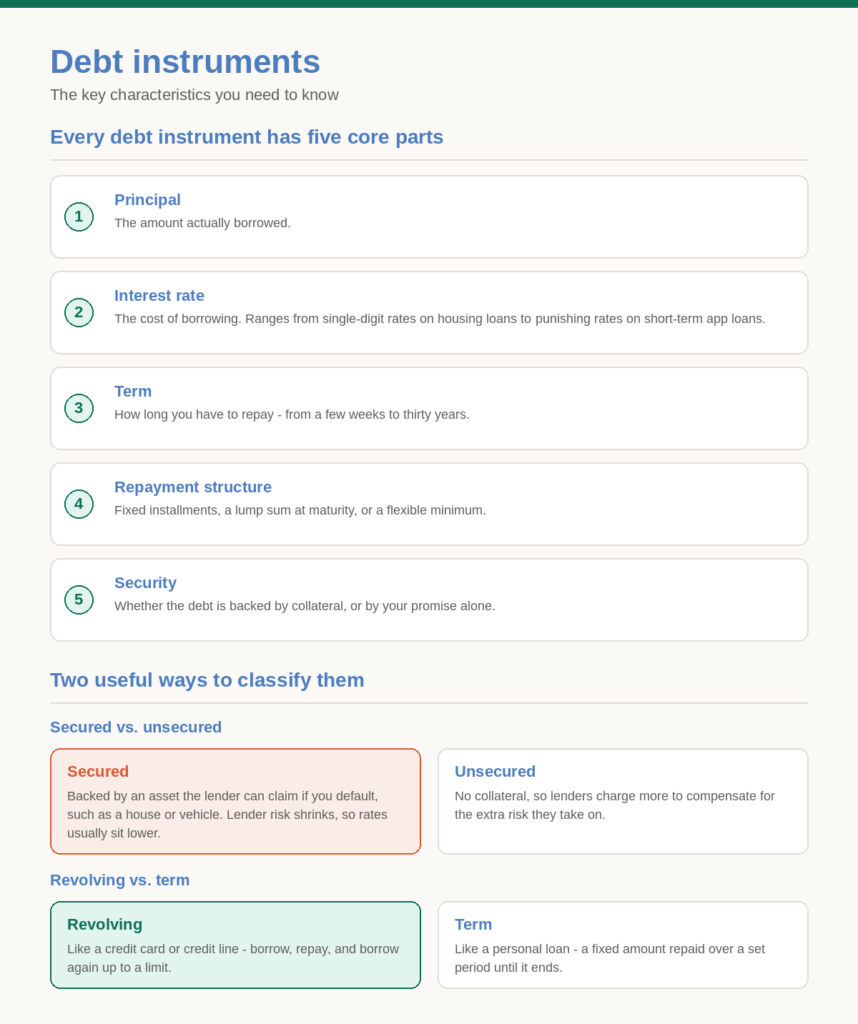
Every debt instrument, no matter how simple, has the same core parts.
- Principal. The amount actually borrowed.
- Interest rate. The cost of borrowing, expressed as a rate. This is where instruments differ most dramatically, from single-digit rates on housing loans to punishing rates on short-term app loans.
- Term. How long you have to repay, from a few weeks to thirty years.
- Repayment structure. Whether you pay fixed installments, a lump sum at maturity, or a flexible minimum.
- Security. Whether the debt is backed by collateral or by your promise alone.
Two useful ways to classify them:
- Secured versus unsecured. A secured instrument is backed by an asset the lender can claim if you default, such as a house or a vehicle. The lender’s risk shrinks, so rates usually sit lower. An unsecured instrument has no collateral, so lenders charge more to compensate for that risk.
- Revolving versus term. A revolving instrument, like a credit card or a credit line, lets you borrow, repay, and borrow again up to a limit. A term instrument, like a personal loan, gives you a fixed amount repaid over a set period until it ends.
Debt Instruments Examples in the Philippines
Here are the debt instruments most Filipinos actually hold.
- Credit cards. Revolving and unsecured. Convenient when paid in full each month, but among the most expensive instruments you can hold if you carry a balance.
- Personal loans. Term-based and usually unsecured. A lump sum from a bank or lending company, repaid in fixed monthly installments, often used for emergencies or consolidation.
- Salary loans. Term-based, borrowed against your future pay through an employer, SSS, GSIS, or a bank, with payments deducted automatically.
- Auto and motorcycle loans. Term-based and secured by the vehicle itself. Miss enough payments and the lender can repossess it.
- Housing loans. Term-based and secured by the property, whether through a bank or Pag-IBIG. Typically the longest and lowest-rate instrument most people will ever hold.
- Installment and paylater plans. Short-term instruments for gadgets, appliances, or purchases, either through a store or an app. Easy to enter, and easy to accumulate without noticing.
- Online lending app loans. Short-term, unsecured, and typically the most expensive instrument available. Fast approval, but the effective cost over a short term can be severe.
- Pawnshop and cooperative loans. Asset-backed short-term borrowing and community-based lending, both widely used for quick access outside the banking system.
- Informal lending. Arrangements such as five-six borrowing are still debt instruments in practice, even without paperwork, and they usually carry the highest cost of all.
When Debt Instruments Build Into a Debt Crisis
A personal debt crisis is not one bad loan. It is the point where the combined obligations from all your debt instruments outgrow what your income can realistically carry.
It builds quietly. A credit card balance carried over, a salary loan for an emergency, two installment plans, then a lending app to cover a slow month. Each one looked manageable on its own. Together, they start consuming the majority of your take-home pay before you have paid for food or transport.
The clearest warning signs are worth knowing:
- Your total monthly debt payments exceed roughly 35 to 40 percent of your income.
- You are using one debt instrument to pay another, such as a cash advance or new app loan to cover a card payment.
- You only ever pay the minimum on revolving instruments.
- You have begun missing due dates or choosing which creditor to pay this month.
- New borrowing is going to everyday expenses rather than one-off needs.
That second sign matters most. Borrowing from one instrument to service another is the moment a difficult situation stops correcting itself on its own, because the total keeps rising while the interest compounds. Rising household borrowing across the country has made this pattern more common, and it is the single most reliable predictor that debt has moved from manageable to critical.
What to Do Before It Becomes a Crisis
The earlier you act, the more options you have and the cheaper they are.
- Start by mapping every debt instrument you hold in one place: the lender, the balance, the interest rate, the minimum payment, and the due date. Seeing the full picture removes the fear of the unknown and usually reveals that one or two high-rate instruments are causing most of the damage.
- From there, prioritize the most expensive instruments first, stop opening new ones while you clear the old, and build even a small emergency buffer so the next surprise expense does not become the next loan. If a payment is becoming difficult, contact the lender before you miss it. Lenders generally have far more room to restructure for a borrower who is still current than one already in default.
When things are not working as you want, FLIN comes in to give you the solution. FLIN is a debt resolution facilitator, not a lender. The aim is not to hand you another debt instrument, but to look at your full picture, work out which options are genuinely available to you, whether that is restructuring, consolidation, or negotiation, and help you move toward a single repayment path you can actually sustain. Click button below to do free consultation
For more info about how to manage the debt click below:
Your Debt-Free Life Start Here
Consult with us and get the best solution based on your financial condition
SEC Registered
SEC Registration number : 2026040247321-01