
Debt Solution
How to Get Out of Debt, A Step by Step Guide for Filipino Employees
If you earn a fixed salary, you have one big advantage in getting out of debt and one big trap. The advantage is predictability. You know exactly what lands in your account and when, which makes a real plan possible. The trap is that a fixed income does not stretch when the bills grow, so debt can quietly climb until most of your sahod is gone before payday even settles in.
This guide is built specifically for employees on a steady paycheck. It walks through how to get out of debt, step by step, including the faster route when your budget allows it, and how to handle long-term debt without letting it run your life.
💡 Highlights
- Getting out of debt on a fixed salary starts with knowing two numbers: your total debt and your real monthly surplus.
- List every debt, then attack them in order, either smallest balance first for motivation or highest interest first to save the most money.
- Pay the minimum on everything, and throw every spare peso at one target debt at a time.
- To get out of debt faster, widen the gap between income and spending, then send the entire difference to your debts.
- Long-term debt such as a housing or auto loan is normal and often healthy, as long as its payment fits comfortably in your budget.
- The current portion of a long-term debt is simply the part due within the next twelve months, and it is what your budget has to cover now.
- If your minimum payments already exceed what your salary can carry, the problem is structural, and restructuring or consolidation may be the realistic path.
First, Understand Where You Actually Stand
Before any strategy, you need two honest numbers.
- The first is your total debt. List every single one: credit cards, salary loans, the SSS or Pag-IBIG loan, auto or motorcycle loan, appliance installments, paylater balances, lending app loans, and any utang to family. For each, write down the outstanding balance, the interest rate, and the minimum monthly payment.
- The second is your real monthly surplus. Take your net take-home pay and subtract your genuine essential spending: rent, food, utilities, transport, and the minimum payments on all your debts. Whatever is left is your surplus, and it is the fuel for everything that follows.
How to Get Out of Debt: The Step by Step Method
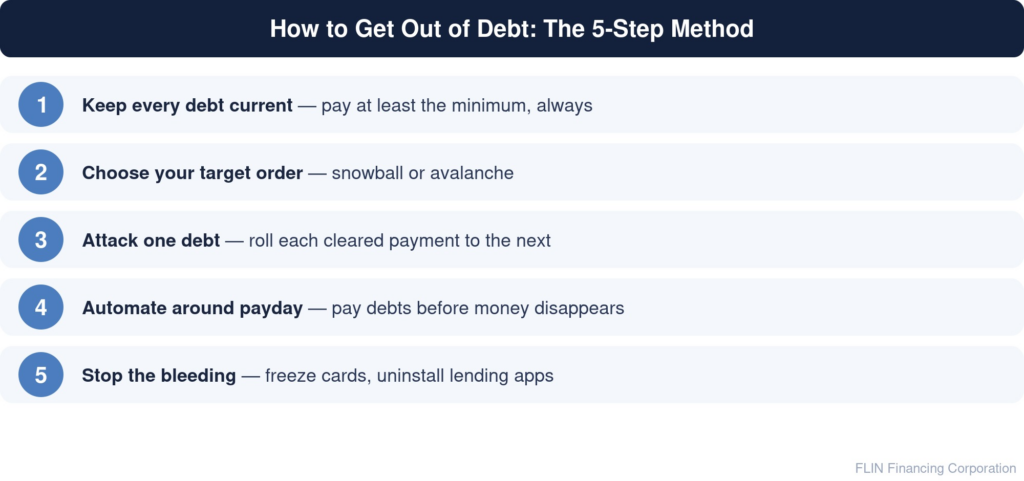
Step 1: Keep every debt current
Pay at least the minimum on every debt, every month, without fail. This protects you from penalties, rising interest, and collection activity. Missing minimums makes everything more expensive and undoes your progress, so this is non-negotiable.
Step 2: Choose your target order
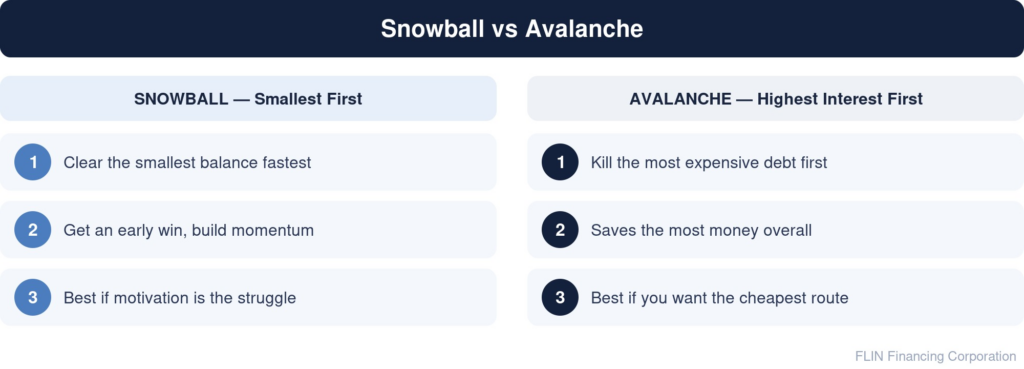
You will attack one debt at a time with your surplus while paying minimums on the rest. Two proven ways to order them:
- Smallest balance first, the snowball. You clear the smallest debt fastest, get an early win, and build momentum. Best if you have struggled to stay motivated before.
- Highest interest first, the avalanche. You kill the most expensive debt first, which saves you the most money overall. Best if you are disciplined and want the mathematically cheapest route.
For most salaried employees juggling several small balances, the snowball’s motivation tends to win, because a plan you actually finish beats a cheaper plan you abandon.
Step 3: Focus One Debt at a Time
Send your entire surplus to your target debt on top of its minimum. When it clears, do not absorb that money back into daily spending. Take the full payment you were making and add it to the next debt on your list. This rollover is the engine of the whole method. Each cleared debt makes the next one fall faster.
Step 4: Automate around your payday
This is where a fixed salary becomes a superpower. Set your payments and transfers to move automatically right after your salary lands, before the money has a chance to disappear. Paying yourself and your debts first, then living on what remains, is far more reliable than trying to save whatever is left at month-end, which is usually nothing.
Step 5: Stop Borrowing Before It’s Getting Worse
A plan fails if new debt keeps flowing in. While you are paying down, freeze the credit cards you are clearing, uninstall the lending apps, and pause new installment purchases. You cannot fill a bucket that still has a hole in it.
How to Get Out of Debt Fast
Getting out of debt faster is not magic. It comes down to one thing: widening the gap between what you earn and what you spend, then sending all of that gap to your debts. There are two levers.
- Increase income. For salaried employees, this might mean overtime, a sideline or raket, freelance work on weekends, selling things you no longer use, or converting a skill into extra pesos. Every added peso that goes straight to debt shortens the timeline.
- Cut spending temporarily. This is not forever. It is a focused sprint. Trim subscriptions, cook instead of ordering, pause non-essentials, and renegotiate what you can. Treat it like a season, not a life sentence.
The accelerator that costs nothing: put every windfall straight into debt. Your 13th month pay, a bonus, a tax refund, cash gifts. These are the single fastest way for a salaried worker to knock down a balance, precisely because they are money you were not relying on for daily life. One 13th month pay aimed at your highest debt can do what months of small payments cannot.
A word of caution on getting out fast: never sacrifice your minimum payments or your small emergency buffer to overpay one debt. Speed that triggers a missed payment elsewhere is not speed. It is a step backward.
Understanding Long-Term Debt on a Salary
Not all debt is a fire to put out. Long-term debt is any debt repaid over an extended period, typically more than a year, and for most Filipino employees the main examples are a housing loan and an auto or motorcycle loan.
Long-term debt is often healthy debt. A Pag-IBIG or bank housing loan builds equity in a home instead of paying rent forever, and it usually carries the lowest interest rate you will ever get. The goal with this kind of debt is not to panic-pay it off ahead of your high-interest debts. It is to make sure its monthly payment sits comfortably within your budget and does not crowd out everything else.
The order matters. Clear your expensive, short-term debt first, the credit cards and app loans, before throwing extra money at a low-rate housing loan. Paying off cheap debt early while expensive debt still burns is one of the most common mistakes salaried borrowers make.
What Is the Current Portion of Long-Term Debt?
You may see the phrase “current portion of long-term debt” and find it intimidating. It is simpler than it sounds.
The current portion of a long-term debt is the part of that debt due within the next twelve months. If you have a housing loan with fifteen years left, the whole balance is long-term debt, but the twelve months of payments coming up in the next year are the current portion.
Why it matters to you as an employee: your monthly budget does not deal with the entire fifteen-year balance. It deals with the current portion, the payments due now. When you plan your salary against your debts, this is the number that belongs in your monthly math. Thinking of a huge long-term balance in terms of its current portion turns an overwhelming figure into a manageable monthly line you can actually plan around.
Common Mistakes People Make When Getting Out of Debt
Getting out is only half the job. Staying out is the other half.
Build an emergency fund, even a small one at first. Three to six months of essential expenses is the target, but even twenty thousand pesos set aside stops the next surprise from becoming the next loan. This single habit breaks the borrowing cycle more than any other.
Use credit as a tool, not a bridge. A credit card paid in full every month is convenient. A card carried as a permanent balance is a trap. Know which one you are holding.
Give every peso of your salary a job before payday arrives, so your money is directed rather than drifting. And revisit your plan whenever your income or expenses change, because a plan that fit last year may not fit now.
When Getting Out of Debt Needs More Than a Budget
Here is the honest part. Sometimes you run the numbers and there is simply no surplus, because the minimum payments alone already eat more than your salary can give. When that happens, no amount of budgeting or motivation fixes it, because the problem is not your habits. It is the structure of the debt itself.
That is the role FLIN plays as a debt resolution facilitator: mapping out which options are genuinely open to you, whether restructuring, consolidation, or negotiation, and helping you land on a single repayment path that fits what your salary can realistically carry. A short, no-pressure consultation is enough to see what is actually possible.Click button below for free consultation.
Find out other tips how to manage your debt easily without taking another loan via articles below:
Your Debt-Free Life Start Here
Consult with us and get the best solution based on your financial condition

SEC Registered
SEC Registration number : 2026040247321-01