Uncategorized
Debt Trap : Vicious Cycle of Loan that Slowly Burn Filipinos
You receive your monthly salary then it’s gone, and you are quietly wondering how you will make it to the next payday without borrowing again. If that sounds familiar, you are not lazy and you are not bad with money. You are probably stuck in a debt trap, and the good news is there is a way out.
💡 Highlights
- A debt trap is when your loan payments grow so large that you have to keep borrowing just to stay afloat, and the balance never really goes down.
- Filipino household debt hit a record high in 2025, and much of the pain comes from high-interest online lending apps.
- The clearest sign you are trapped is borrowing from one lender to pay another.
- Getting out starts with two moves: stop taking new loans, and list every debt you have in one place.
- Attack your most expensive debts first, usually the lending apps and carried credit card balances.
- Some loan app interest rates are so high that Philippine courts have thrown them out, so know your rights before you panic.
- If your minimum payments are already bigger than your salary can handle, the fix is not budgeting harder, it is restructuring the debt itself.
What Is a Debt Trap?
A debt trap is simple to describe and painful to live in. It is the point where your debt payments get so heavy that you cannot cover your normal expenses anymore, so you borrow again to fill the gap. That new loan adds another payment next month, the gap gets bigger, and you borrow again. Round and round.
The engine behind the trap is interest. When most of your payment goes to interest instead of the actual amount you borrowed, the balance barely moves no matter how much you pay. You feel like you are working hard and getting nowhere, because you are. That is not a personal failure. That is just how high-interest debt is designed to behave.
The key thing to understand: a debt trap is not about how much you owe. It is about whether your income can keep up. Someone with a small salary loan can be trapped, while someone with a big housing loan may be perfectly fine. What matters is the gap between what you owe each month and what you actually earn.
A Landscape of Debt in Philippine
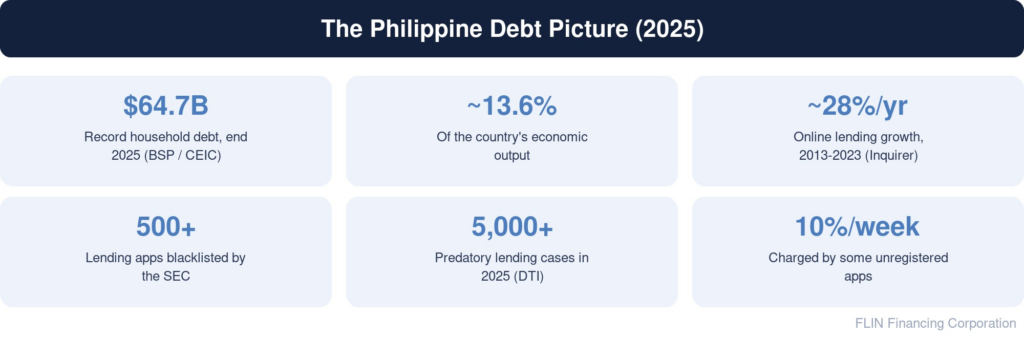
If you feel stuck, look around, because millions of Filipinos are in the same spot. As cited from Bangko Sentral ng Pilipinas data compiled by CEIC, Philippine household debt reached a record 64.7 billion US dollars by the end of 2025, an all-time high, sitting at around 13.6 percent of the country’s economic output. Compared with neighbors like Thailand or Malaysia that number is actually low, but the low figure hides a harder truth.
The bigger problem is where a lot of people turn when they run short: online lending apps. These are everywhere now, easy to download, quick to approve, and brutal on your wallet. As cited from a 2025 report in the Inquirer, the online lending sector in the Philippines grew by about 28 percent a year from 2013 to 2023, and regulators warn that a growing number of borrowers are being trapped in cycles of debt by predatory rates.
The rates are the real trap. As cited from the Department of Trade and Industry, the agency logged over 5,000 cases of predatory lending in 2025, and unregistered foreign apps have been caught charging as much as 10 percent per week. Read that again. Ten percent a week. Borrow ten thousand pesos and you can owe eleven thousand seven days later. That is not a loan, that is a hole.
How to Get Out of a Debt Trap
Getting out is not fast or fancy, but it is very doable. Here is the order that actually works.
1. Stop taking a new loan
This is the hardest step and the most important. You cannot climb out of a hole while you are still digging it. That means no new loans and no new app downloads while you sort this out. Delete the lending apps if you have to. Freeze the credit card in a drawer. The trap only works if new debt keeps flowing in, so the first move is to shut off the tap.
2. Note all debts you have
Grab a piece of paper or your Notes app and write down every single debt. All of it. Credit cards, salary loan, SSS or Pag-IBIG loan, app loans, appliance installments, utang to your tita. For each one, write three things: how much you still owe, the interest rate, and the minimum monthly payment.
This step feels scary, and most people avoid it for exactly that reason. But you cannot beat what you refuse to look at. Once it is all on one page, the fog lifts, and you will almost always see that one or two high-interest loans are causing most of the damage.
3. Create a list of payment priority
Now look at your list and find the debts with the ugliest interest rates. For most people that is the online lending apps and any credit card balance you have been carrying. Those are the ones bleeding you dry.
The plan is simple. Keep paying the minimum on everything so nothing goes into default. Then take every spare peso you can find and throw it at that one worst loan until it is dead. When it is gone, take the money you were paying on it and pile it onto the next worst loan. Then the next. Each loan you kill frees up more cash for the next one, so you speed up as you go.
4. Know your rights as a debtor
Here is something most trapped borrowers do not know. Those sky-high app rates are not always legal. As cited from legal analysis by Respicio and Co. on Philippine court rulings, courts have struck down interest rates they consider unconscionable. In one 2024 case, a court threw out an app’s 0.5 percent daily rate, which works out to more than 182 percent a year, and reduced it to just 6 percent per year.
Two more things worth knowing. As cited from Article III, Section 20 of the 1987 Constitution, you cannot be jailed for an unpaid loan in the Philippines, so any collector threatening you with arrest is bluffing. And the harassment many apps use, the threats, the shaming, the texting of your contacts, is illegal. You can report it to the SEC, the DTI, the BSP, or the National Privacy Commission. Knowing this changes everything, because you stop negotiating from fear.
5. Save some money
The math of escaping a trap is just widening the gap between what comes in and what goes out, then sending that gap to your debts. Cut what you can for a few months and treat it like a sprint. And the fastest weapon a salaried worker has is your 13th month pay and any bonus. Aim those straight at your worst debt instead of letting them disappear. One 13th month pay pointed at the right loan can do what months of small payments cannot.
6. If the numbers still do not add up, change the structure
Sometimes you do all of the above, and there is still no way to make it work, because the minimum payments alone are already bigger than your salary can carry. That is not you failing. That means the shape of the debt is the problem, not your effort.
At that point the smart move is to change the debt itself. That usually means restructuring, asking a lender for lower payments over a longer term, or consolidation, rolling several messy debts into one payment you can actually afford. Done right, this can turn five panic-inducing due dates into one calm one.
How to Stay Out Once You Are Free
Climbing out is half the battle. Staying out is the other half, and it comes down to one habit above all: build a small emergency fund. Even twenty thousand pesos set aside means the next flat tire or hospital visit does not send you straight back to a lending app. That single buffer is what breaks the cycle for good.
After that, keep it simple. Give every peso of your salary a job before payday, so your money is going where you decide instead of just vanishing. Use your credit card only for what you can pay in full each month. And if a loan ever starts feeling heavy again, deal with it early, while it is still small, when you have the most options.
Debt Consolidation to Help You Out From Debt Trap
If you have read this far and thought “I have tried, and the math just does not close,” that is worth taking seriously. When your payments have genuinely outgrown your paycheck, no budgeting trick fixes it, because the problem is baked into the loans themselves.
Don’t worry, sometimes, there’s a solution that you haven’t found yet. Here we are FLIN, debt consolidation company that can help you out of debt trap. We can merge all of your debts into one manageable installment.
We can help you in managing online loan, credit card, personal loan and unsecured debt. The process is really simple, you only need to click button below for consultation and the process can be done online.
Debt-free and live happily!
Find out more about other tips to help you debt-free via articles below:
Your Debt-Free Life Start Here
Consult with us and get the best solution based on your financial condition

SEC Registered
SEC Registration number : 2026040247321-01