
Uncategorized
Is There a Legal Way to Restructure My Debt in the Philippines?
If your debt has grown heavier than your income can carry, you have probably wondered if there is a legit way out, or if you are just stuck. Here is the good news, said plainly: yes, there is a legal way to restructure your debt in the Philippines, and it is a normal, recognized process, not some shady loophole.
Key Highlights
- Debt restructuring means changing the terms of your loan so the payments become easier to handle.
- It is completely legal in the Philippines and is a normal option that banks and lenders deal with all the time.
- Common legal ways include negotiating directly with your lender, joining a credit card relief program, or restructuring government loans like SSS and Pag-IBIG.
- For very severe cases, there is even a court-supervised process under a law called FRIA.
- Restructuring usually means a lower monthly payment, a longer time to pay, or fewer penalties.
- You have the right to fair treatment and clear written terms during the whole process.
- A debt resolution facilitator can handle the negotiating for you if doing it alone feels overwhelming.
What Does It Mean to Restructure Debt?
Restructuring your debt simply means changing the original terms of your loan so it becomes something you can actually afford. Instead of struggling with payments you cannot meet, you and the lender agree on new terms that work better for your situation.
This can take a few shapes. It might mean stretching the loan over a longer time so the monthly payment shrinks. It might mean lowering the interest rate. It might mean freezing or reducing the penalties that piled up while you were behind. Or it might mean turning a messy revolving balance into a fixed, predictable installment plan. The goal is always the same: make the debt manageable so you can keep paying instead of defaulting.
Is Debt Restructuring Legal in the Philippines?
Yes, completely. There is nothing sketchy about it. Under Philippine law, changing the terms of a loan by mutual agreement is a normal, recognized act. The Civil Code allows a loan agreement to be replaced with new terms when both sides agree, which is the legal backbone of every restructuring deal.
Banks and lenders actually prefer this in many cases, because a borrower who keeps paying under easier terms is far better for them than one who defaults completely. So restructuring is not asking for a favor or trying to escape your debt. It is a legitimate business arrangement that often helps both sides.
What Are the Legal Ways to Restructure Debt?
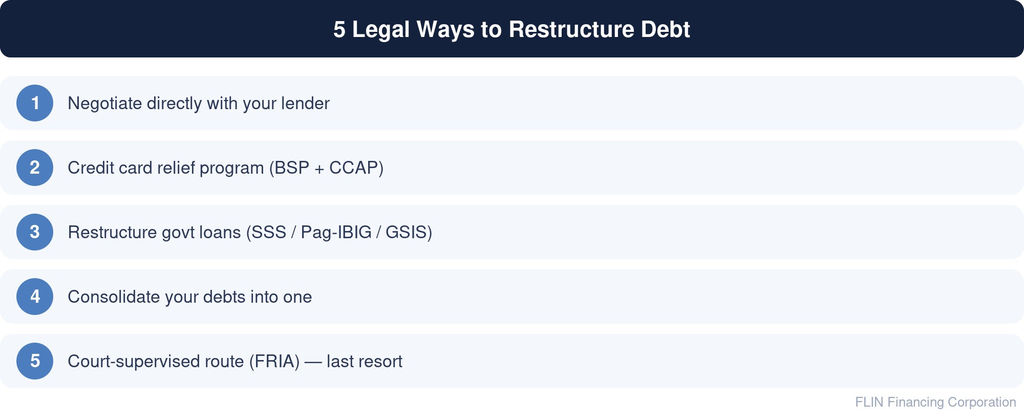
There are several legal routes, and the right one depends on your situation. Here are the main ones.
Negotiate directly with your lender. This is the most common path. You contact your bank or lending company, explain your situation, and ask about restructuring. Many banks have formal programs for this, such as converting your outstanding balance into a fixed-term loan at a lower monthly rate, extending your payment period, or waiving some penalties if you show real intent to pay.
Restructure government loans. If your debt includes government loans, these often have their own restructuring or condonation programs. SSS, Pag-IBIG, and GSIS have all offered ways for members to restructure past-due loans, sometimes with penalties reduced or waived. It is worth asking these agencies directly what programs are currently open.
Consolidate your debts. Debt consolidation is a form of restructuring where several debts are combined into one single, more manageable payment. Instead of many due dates and lenders, you deal with just one, often at a lower overall cost.
Use the court-supervised route for extreme cases. For truly severe situations, the Philippines has a law called the Financial Rehabilitation and Insolvency Act, often shortened to FRIA. It gives individuals and businesses a legal, court-supervised way to reorganize or suspend payments when debts have become impossible to pay. This is a serious step and usually a last resort, but it exists precisely so that people in deep financial trouble have a lawful way forward.
How Do You Start Restructuring Your Debt?
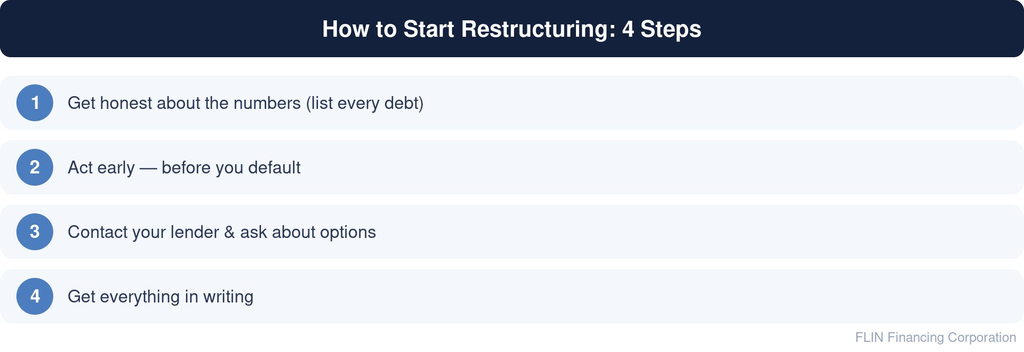
Getting started is more straightforward than most people fear. Here is a simple order to follow.
First, get honest about the numbers. List every debt you have, with the balance, the interest rate, and the monthly payment. You cannot restructure what you have not laid out clearly.
Second, act early, before you default if you can. Lenders have far more room to help a borrower who reaches out while still trying than one who has already gone silent for months. So do not wait for the situation to explode.
Third, contact your lender and ask specifically about their restructuring options. Explain your situation honestly, show that you intend to pay, and ask what terms they can offer. Come prepared with proof of income and any proof of hardship, like a medical bill or notice of reduced pay.
Fourth, get everything in writing. Never rely on a verbal promise. Make sure the new terms, the interest, the schedule, and any waived penalties are all clearly documented before you agree.
What Are Your Rights When You Restructure?
You are not powerless in this process. Philippine consumer protection rules, including the Financial Products and Services Consumer Protection Act, require lenders to treat you fairly and to give you clear, honest information about your options and the true cost of any new arrangement.
You also have the right to be free from harassment. Even if you are behind, collectors cannot threaten you, shame you, or contact your family and officemates to pressure you. And remember, you cannot be jailed for an ordinary unpaid loan, so you are always negotiating from a place of safety, not fear.
Will Restructuring Hurt My Credit Score?
This is a fair worry, so here is the honest answer. Restructuring may show up on your credit record, and in the short term it can look less than perfect. But here is the important part: it is almost always far better for your credit than simply defaulting and letting the debt go unpaid.
A restructured loan that you pay faithfully shows lenders that you took responsibility and kept your commitment. Over time, those steady, on-time payments help rebuild your credit standing. Defaulting, on the other hand, leaves a much deeper and longer-lasting mark. So between the two, restructuring is the far healthier choice for your financial future.
Getting Help to Restructure the Right Way
If all of this feels like a lot to handle alone, especially the part where you have to negotiate with several lenders at once, you do not have to do it by yourself. Sometimes the hardest part is simply knowing what to ask for and having someone in your corner who does this every day.
That is exactly what FLIN is for. FLIN looks at your whole situation and helps map out the legal restructuring options genuinely open to you, & bring your debts into one manageable plan you can actually sustain. A short, no-pressure chat is enough to see what is possible for you. So yes, there is a legal way to restructure your debt in the Philippines as cited here, and you do not have to figure it out or face your lenders alone. Click below for free consultation.
Find out more about how to restructure your debt via articles below:
Your Debt-Free Life Start Here
Consult with us and get the best solution based on your financial condition

SEC Registered
SEC Registration number : 2026040247321-01