Debt Solution
What Are the Alternatives to Bankruptcy or Insolvency for Individuals in the Philippines?
When debt feels impossible, the word “bankruptcy” starts to sound like the only escape. But here is something most Filipinos do not realize: formal insolvency is usually the heaviest, slowest, and least pleasant way out, and there are several better alternatives you can try first. In fact, most people never need to go through a court insolvency case at all.
💡 Highlights
- The Philippines does have a formal insolvency process for individuals, but it is slow, costly, public, and a real last resort.
- Most people can solve their debt with lighter alternatives that never go to court.
- The main alternatives are negotiating with your lender, restructuring, consolidation, and settlement.
- There are also special programs for credit cards and for government loans like SSS and Pag-IBIG.
- These alternatives are faster, cheaper, more private, and gentler on your credit than formal insolvency.
- The right choice depends on whether you can still pay in some form, or genuinely cannot pay at all.
- A debt resolution facilitator can help you pick and arrange the right alternative for your case.
Is There Such a Thing as Personal Bankruptcy in the Philippines?
Yes, but it works differently from what many people imagine. The Philippines has a law called the Financial Rehabilitation and Insolvency Act, or FRIA, which does cover individuals. Under it, a person can file for something called suspension of payments, if they have enough assets but cannot pay debts as they fall due, or for liquidation, if they are truly insolvent.
Why Should You Avoid Formal Insolvency if You Can?
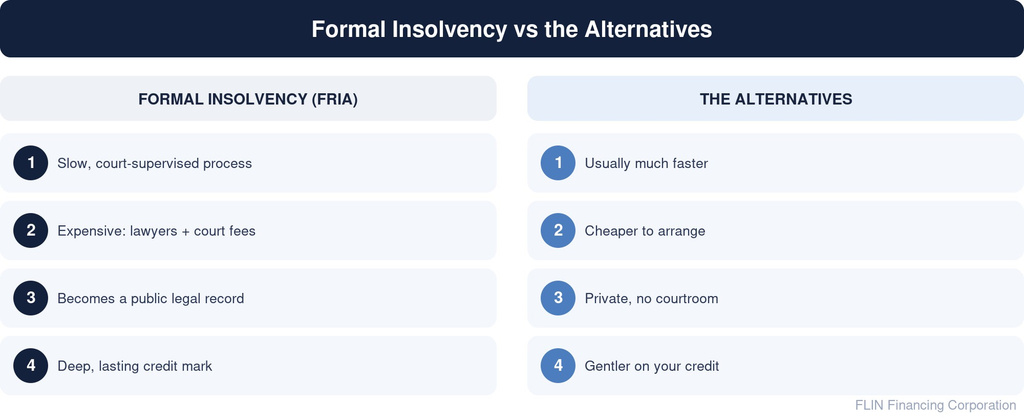
A court insolvency case can be slow, sometimes dragging on for a long time. It can be expensive, since it usually needs lawyers and court fees. It becomes part of a public legal record, which is far from private. And it leaves a deep, lasting mark on your credit standing that can follow you for years.
Compare that to the alternatives, which are usually faster, cheaper, done privately without a courtroom, and much gentler on your future ability to borrow. For the vast majority of people, one of the alternatives below solves the problem long before insolvency ever needs to be on the table.
What Are the Alternatives to Bankruptcy?
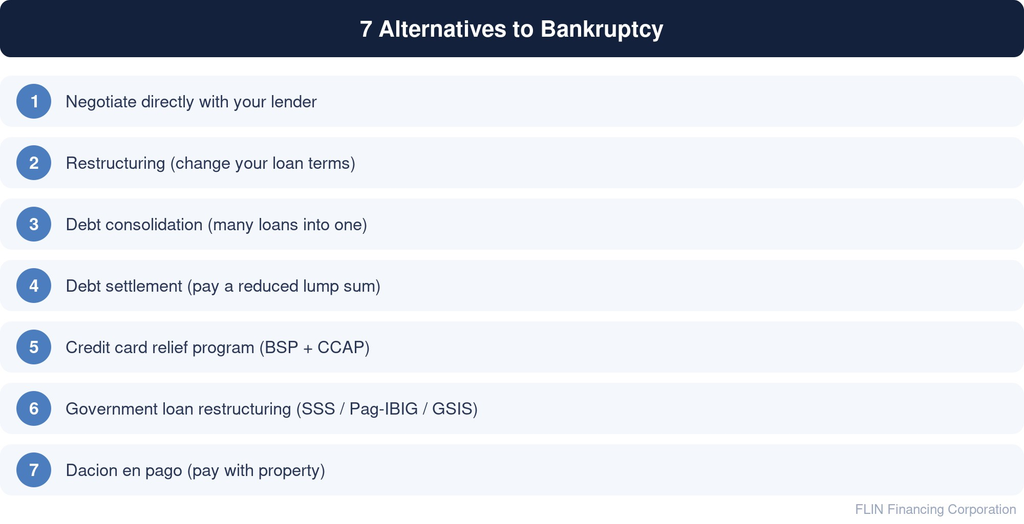
Here are the real options most people should explore first, roughly from lightest to most structured.
Negotiate directly with your lender
The simplest step. Contact your bank or lender, explain your situation honestly, and ask what they can do. Many are willing to lower your payment, extend your term, or waive some penalties, because a paying customer is better for them than a default. Always get the new terms in writing.
Restructuring
This is a formal version of negotiating. Your loan terms are changed, a longer time to pay, a lower interest rate, or frozen penalties, so a payment you could not meet becomes one you can. It keeps you paying and out of default without any court involvement.
Debt consolidation
If you owe several lenders at once, consolidation combines them all into one single, more manageable payment, often at a lower overall cost. Instead of juggling many due dates, you deal with just one. For people drowning in multiple loans, this is often the cleanest fix.
This could be one of the easiest ways that people are not familiar yet. In this case, all of your loans will be merged into one manageable installment and longer tenure. It’s one of FLIN’s products that can save you from an endless loan cycle. Click here to read more about it.
Debt settlement
If you genuinely cannot pay the full amount and are already deep in default, a lender may agree to accept a reduced lump sum to consider the debt closed. This lowers the total you pay, though it does leave a heavier mark on your credit than restructuring. It is best when full repayment is truly out of reach.
Credit card relief program
If your problem is several credit cards from different banks, there is a program run by the BSP together with the Credit Card Association of the Philippines that rolls your card debts into one restructured plan with much lower interest and a longer term. It is designed exactly for people who are seriously stuck on card debt.
Government loan restructuring
If your debts include SSS, Pag-IBIG, or GSIS loans, these agencies regularly offer their own restructuring or penalty-condonation programs. It is always worth asking them directly what is currently open, since these can wipe out penalties and make the balance manageable again.
Paying with property (dacion en pago)
In some cases, you and your lender can agree that you hand over a specific asset to settle the debt, instead of paying cash. This is a recognized, legal arrangement, though it only makes sense when you have an asset you are willing to part with.
How Do You Choose the Right Alternative?
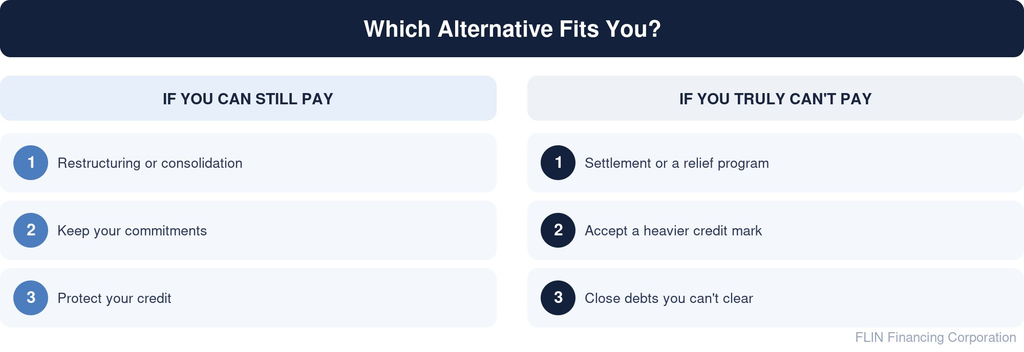
It comes down to one honest question: can you still pay your debt in some form, or genuinely not at all?
If you can still pay, but the problem is high interest or too many due dates, then restructuring or consolidation is usually your best move. You keep your commitments, protect your credit, and simply make the debt manageable.
If you truly cannot pay in full, and you are already far behind, then settlement or one of the relief programs may fit better, accepting a bit more credit damage in exchange for finally closing debts you cannot realistically clear.
And only if none of these can work, when the debt is genuinely beyond any repayment arrangement, does formal insolvency under FRIA become worth considering. For most people, it never comes to that.
When Is Formal Insolvency Actually the Right Call?
To be fair, there are cases where it genuinely fits. If your debts are so far beyond your income and assets that no negotiation, restructuring, or settlement could ever resolve them, then the legal, court-supervised process under FRIA exists precisely to give you a lawful fresh start. It is there for a reason, and there is no shame in using it when it truly applies.
But that is the exception, not the rule. The point is simply this: do not jump to the heaviest option out of fear. Explore the lighter alternatives first, because one of them will very likely solve your problem with far less cost, stress, and lasting damage.
How to Solve This Problem?
The hardest part of all this is often just figuring out which alternative fits you, and then actually arranging it with your lenders. Doing that alone, especially while stressed and behind on payments, can feel overwhelming.
If you’re facing this, don’t be afraid, FLIN is here to help you. All you need to do is click the button below for free consultation. Afterwards, you can do a free one on one consultation to tell you about your financial situation.
FLIN has a debt consolidation service that can help you to reduce your debt by merging all loans into one installment. Get debt-free life right now and free yourself from any burdens!
Find more tips regarding how to manage your money carefully below:
Your Debt-Free Life Start Here
Consult with us and get the best solution based on your financial condition