Debt Solution
I Can’t Pay My Loans Anymore, What Is the Solution in the Philippines?

If you have reached the point where you simply cannot pay your loans anymore, first, take a breath. This feeling is heavy, and the panic is real, but you are not stuck and you are not the only Filipino going through this. Millions are in the same boat right now. What feels like the end of the road is actually a very common, very fixable situation, once you calm down enough to see your options clearly.
💡 Highlights
- The worst move when you can’t pay is to borrow again to cover it. That only deepens the hole.
- The best move is to stay calm, face the numbers, and choose a real plan instead of panicking.
- Your main solutions are negotiating with your lender, restructuring, or consolidating your debts into one.
- Restructuring means changing your loan terms so the payments actually fit your income.
- Consolidation combines many debts into one manageable payment, without taking on new debt.
- You have rights against harassment, no matter how far behind you are.
- If your debts are bigger than your income can handle, that is a structural problem with real solutions.
First, Calm Down. This Is Fixable.
Before anything else, breathe. When you feel like you can’t pay, your mind races and everything feels like an emergency, and that panic is exactly what pushes people into bad decisions, like taking one more high-interest loan just to survive the week. So the first real step is simply to slow down. This situation has solutions, and none of the good ones happen in a panic.
Remind yourself of this: being unable to pay a loan does not make you a failure or a bad person. Life happens. Income drops, emergencies hit, prices rise. What matters now is not how you got here, but the plan you make next. And that plan starts with a clear head.
Why Borrowing Again Is Not the Answer
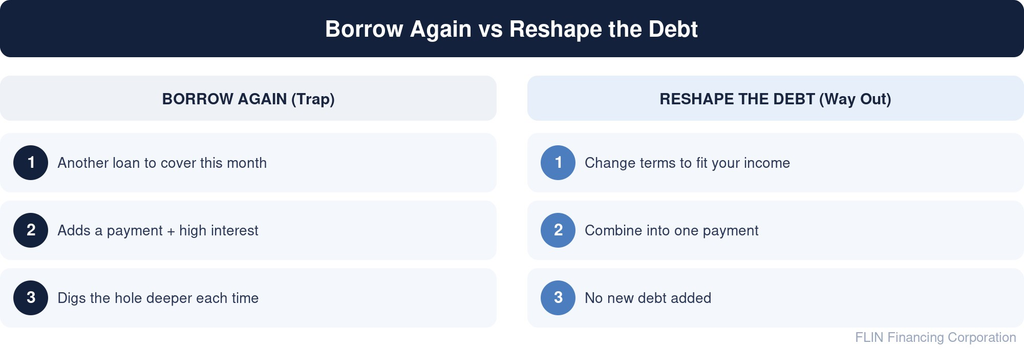
When money is tight, the fastest-looking fix is another loan. Another app, another salary loan, anything to cover what is due this week. It feels like relief, but it is a trap.
Here is why. Every new loan you take adds another payment next month, usually with high interest on top. So you borrow to cover this month, and next month you are even shorter, so you borrow again.
If you are already struggling to pay, adding more debt is like trying to put out a fire with gasoline. The real way out is not more borrowing. It is reshaping the debt you already have, and there are legal ways to do exactly that.
What Is the First Thing I Should Do?
Do not hide. This is the single most important piece of advice. When people can’t pay, their instinct is to ignore the calls, avoid the letters, and hope it all disappears. It does not. It only grows quieter right before it gets louder, and hiding removes every good option you have.
Instead, face the numbers. Sit down and list every loan you have, with the balance, the interest rate, and the monthly payment. Seeing the full picture is uncomfortable, but it is the first real step toward control. Once it is all laid out, you can actually start solving it, and you will usually find the situation is more workable than the fear made it feel.
Can I Talk to My Lender if I Can’t Pay?
Yes, and you absolutely should. This surprises people, but lenders generally prefer a paying customer over one who defaults completely. A borrower who reaches out honestly is far easier for them to work with than one who vanishes.
So contact your lender before you miss too many payments, if you can. Explain your situation honestly, show that you intend to pay, and ask what options they have. Many banks and lenders have real programs for exactly this, like lowering your monthly payment, extending your loan, or waiving some penalties. Come prepared with proof of income and any proof of hardship, such as a medical bill or a notice of reduced pay. And always get any new agreement in writing.
What Are the Real Solutions if I Can’t Pay My Loans?
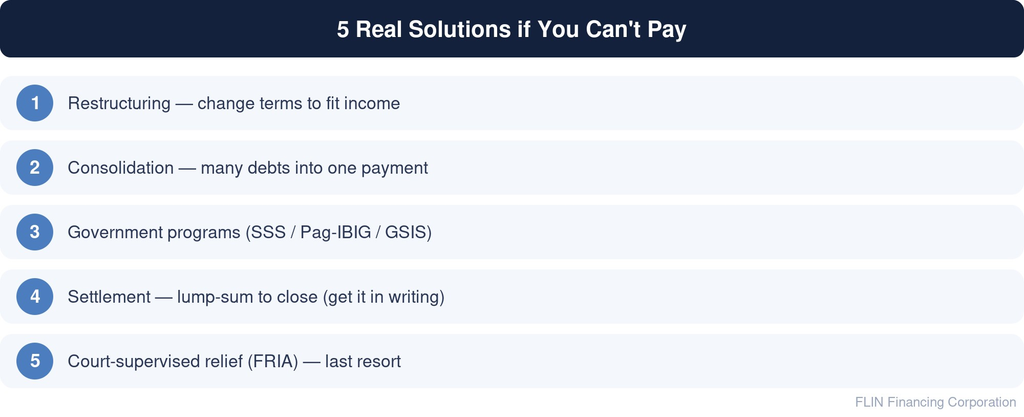
Here are the main legal ways out, and one of them will usually fit your situation.
Restructuring. This means changing the terms of your loan so the payments become affordable. It might stretch the loan over a longer time to shrink the monthly amount, lower the interest, or freeze the penalties that piled up. It turns a payment you can’t make into one you can.
Consolidation. If you owe several lenders at once, consolidation combines them all into one single, more manageable payment. Instead of juggling many due dates, you deal with just one, often at a lower overall cost. For many people, this is the cleanest way out of a tangled mess of debts.
Government loan programs. If your debts include SSS, Pag-IBIG, or GSIS loans, these agencies often have their own restructuring or condonation programs, sometimes with penalties reduced or waived. It is worth asking them directly what is currently available.
Settlement. In some cases, especially when you are already far behind, a lender may accept a lower lump-sum amount to consider the debt settled. This can bring real relief, but always get the terms in writing.
Court-supervised relief for extreme cases. For truly severe situations, the Philippines has a law called the Financial Rehabilitation and Insolvency Act, which gives a legal, court-supervised way to reorganize debts that have become impossible to pay. This is a serious last resort, but it exists precisely so that people in deep trouble have a lawful path forward.
What Are My Rights if I Fall Behind?
You still have rights, no matter how far behind you are. Even when you can’t pay, collectors are not allowed to threaten you, curse at you, shame you publicly, or contact your family, friends, and officemates to pressure you. Those tactics are illegal, and you can report them to the SEC, the BSP, or the National Privacy Commission.
And there is one more thing worth knowing, so the fear does not control your decisions: an ordinary unpaid loan is a civil matter, not a crime, so you are dealing with this from a place of safety. That means you can handle every call calmly and focus on the real plan, instead of being scared into another bad loan.
What if My Debts Are Just Bigger Than My Income?
Sometimes you do the math honestly and there is simply no way to make it work, because even the minimum payments are already more than your salary can cover. Please hear this clearly: that is not a personal failure. It means the problem is the size and structure of your debt, not your effort or your character. And a structural problem like that has structural solutions, which is exactly the point of restructuring and consolidation.
This is where FLIN comes in, working as a debt resolution facilitator and not a lender. Instead of offering you another loan, FLIN looks at your whole situation and helps bring your debts into one manageable plan, working to lower your payments and negotiate with your lenders on your behalf. The goal is simple: to turn debts you can’t pay into one payment you can. A short, no-pressure chat is enough to see what is possible for you. When you feel like you can’t pay anymore, it truly feels like the end. But it is not. It is the moment to reach for a plan, and you do not have to build that plan alone.
Find out more about how to manage your debt with the best solution below:
Your Debt-Free Life Start Here
Consult with us and get the best solution based on your financial condition
SEC Registered
SEC Registration number : 2026040247321-01