
Debt Solution
How Do I Get Out of Debt If My Salary No Longer Covers My Monthly Payments?

This is the hardest place to be. Not “money is tight,” but “the math simply does not work.” Your loan payments add up to more than your entire salary, so no matter how carefully you budget, you come up short every month. If this is you, start by listing all your debts, checking the size of your monthly shortfall, and contacting your lenders to discuss possible repayment arrangements. Depending on your circumstances, options may include debt restructuring, debt consolidation, settlement, or an eligible debt-relief program. For detailed information, check below.
This guide walks you through what to do when your income genuinely cannot cover your debts, in plain language, made for regular working people.
💡 Highlights
- If your minimum payments are bigger than your salary, budgeting alone cannot fix it, and that is not your fault.
- This is a structural problem, so the shape of your debt has to change, not just your spending.
- Stop taking new loans immediately. Borrowing to cover the gap only makes it worse.
- List every debt so you can see the full picture and the real size of the shortfall.
- Your real solutions are restructuring, consolidation, settlement, and relief or condonation programs.
- You cannot be jailed for an unpaid loan, so you can face this calmly instead of in fear.
- The goal is to reshape the debt to fit your salary, not to stretch your salary to fit the debt.
Why Budgeting Alone Will Not Fix This
At some point, the usual advice stops working. “Spend less, make a budget, pay extra” all assume you have money left over after your payments. But when your minimums already exceed your take-home pay, there is nothing left to budget with. You could cut every non-essential and still fall short.
This realization is freeing once it clicks: your problem is not discipline, it is structure. The total size of your debt and its payment terms have outgrown your income. So the fix is not to squeeze harder. It is to change the debt itself. Once you stop blaming yourself and start thinking structurally, the real solutions come into view.
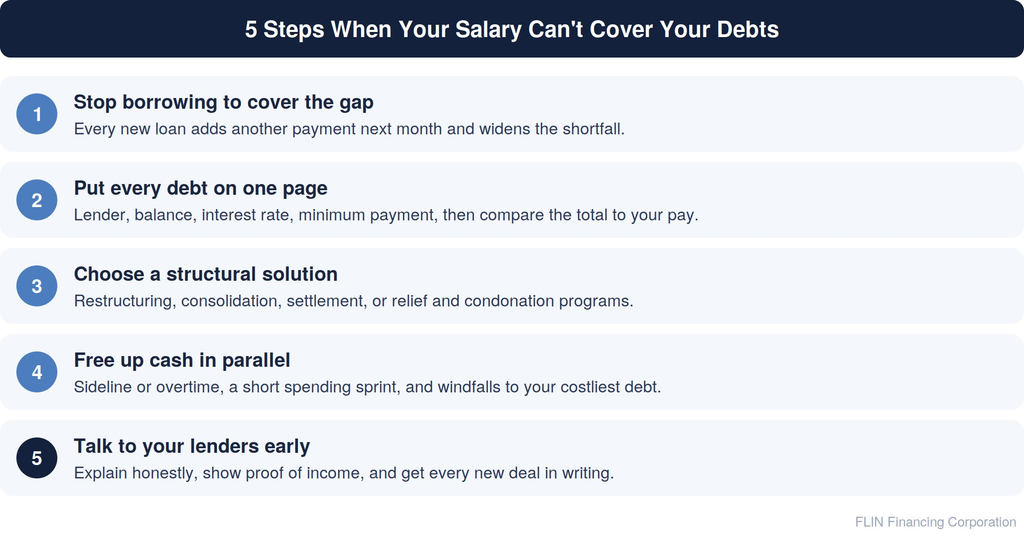
5 Steps to Take When Your Income Can’t Cover Your Debts
Step 1: Stop taking on More Debt to Cover Existing debts
When you are short every month, the most tempting move is to grab another loan or app to cover the gap. Don’t. It is the fastest way to turn a bad situation into a catastrophic one, because every new loan adds another payment next month and widens the very gap you were trying to close. It is “gali ng lubang, tabon ng lubang,” and it only digs you deeper. Your first real step is to stop taking on new debt, starting today.
Step 2: Put the Whole Picture on One Page
You cannot solve what you cannot see. List every debt you have: the lender, the balance, the interest rate, and the minimum monthly payment. Add up all the minimums and compare the total to your take-home pay.
Seeing the exact size of the shortfall is uncomfortable, but it turns a vague, crushing dread into a concrete number you can work with. It also shows you which debts, usually the high-interest apps and cards, are doing the most damage.
Step 3: Know Your Real Solutions
When your income cannot cover your payments, these are the moves that genuinely change the equation.
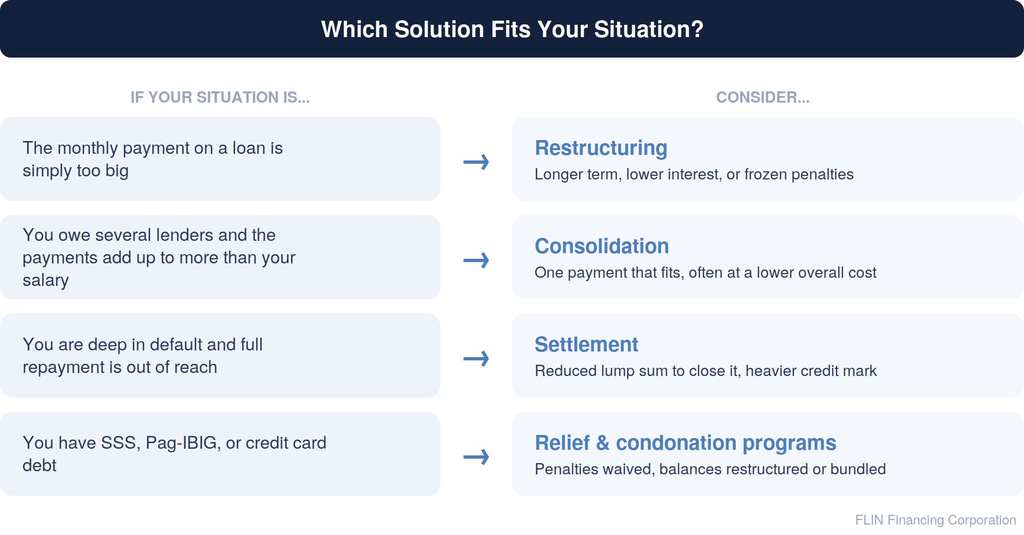
Restructuring. You ask your lender to rework the loan into something you can afford, usually by stretching the term so the monthly payment drops, lowering the interest, or freezing penalties. This directly shrinks what you pay each month, which is exactly what you need when the monthly number is the problem.
Consolidation. If you owe several lenders, consolidation combines them into one single payment, often over a longer term and at a lower overall cost. Instead of five payments that together blow past your salary, you get one that fits. For most people in a salary-shortfall situation, this is the central solution.
Settlement. If you are already deep in default and truly cannot pay in full, a lender may accept a reduced lump sum to close the debt. It lowers the total, but it leaves a heavier mark on your credit, so it is best reserved for when full repayment is genuinely out of reach.
Relief and condonation programs. For government loans like SSS and Pag-IBIG, there are regular programs that waive penalties and restructure your balance. For credit cards, there is a relief program that bundles your cards into one lower-interest plan. These can meaningfully cut what you owe each month.
Step 4: Free Up Whatever You Can, in Parallel
Reshaping the debt is the main event, but widening the gap from the other side helps too. On the income side, even a temporary sideline, overtime, or selling things you no longer use adds breathing room. On the spending side, trim hard for a season and treat it as a sprint, not forever. Aim any windfall, like your 13th month pay or a bonus, straight at your most expensive debt.
None of this alone will close a big shortfall, but combined with restructuring, it speeds up your recovery.
Step 5: Talk to Your Lenders Early and Honestly
Reach out before you default if you still can. Lenders have far more room to help a borrower who is still trying than one who has gone silent for months. Explain your situation honestly, show proof of income and any hardship, and ask specifically about restructuring or hardship programs. Get every new arrangement in writing before you agree.
Many lenders would genuinely rather accept smaller payments than get nothing at all.
What You Don’t Need to Fear
The pressure of this situation can make small threats feel enormous, so let’s clear this up. You cannot be jailed for an ordinary unpaid loan, because it is a civil matter under the Constitution. And no collector may harass you, shame you, or contact your family and officemates, no matter how far behind you are.
Knowing this lets you negotiate and plan calmly instead of making panicked decisions out of fear.
Note: This article is general information, not legal advice. For a complicated situation, free legal help is available from the Public Attorney’s Office if you qualify.
When You Need Someone to Reshape It With You
Here is the honest heart of it. When your salary cannot cover your payments, the answer is almost never “try harder with your budget.” It is to restructure what you owe so the monthly number finally fits your income. Doing that across several lenders at once, while you are stressed and stretched thin, is genuinely hard to pull off alone.
FLIN exists for exactly this moment. FLIN helps salaried Filipinos combine high-interest debts, online loans, credit cards, and buy-now-pay-later balances into one more manageable monthly payment.
A short, no-pressure consultation is enough to see what is possible for you. When the math does not work, you don’t force your salary to stretch. You reshape the debt, and that is something you can absolutely do, with the right help in your corner.
Read more about how to solve debt properly via articles below:
Your Debt-Free Life Start Here
Consult with us and get the best solution based on your financial condition

SEC Registered
SEC Registration number : 2026040247321-01