Debt Consolidation
Do Banks in the Philippines Offer Debt Consolidation, and What Do They Require?
If you have several debts and want to combine them into one bank loan, the answer is yes, banks in the Philippines offer debt consolidation. But getting approved depends on meeting certain requirements, and those requirements can be hard to meet if you are already deep in debt. Check below for more detailed information!
💡 Highlights
- Yes, banks offer debt consolidation, usually through a personal loan you use to pay off your other debts.
- Most consolidation loans are unsecured, so you often do not need collateral.
- To qualify, banks check your age, income, employment, and credit history.
- Typical minimum income is around 15,000 to 30,000 pesos a month, depending on the bank.
- They also check your debt-to-income ratio, usually wanting your total payments under about 40 percent of your income.
- Bank consolidation is easiest to get if your credit is still good, which is hard if you are already behind.
- If a bank rejects you, there are other ways to consolidate that do not need a new loan approval.
Do Banks Actually Offer Debt Consolidation?
Yes. Most major commercial banks and digital banks in the Philippines offer debt consolidation, though often not under that exact name. As Philippine legal guidance explains, the term “debt consolidation loan” may appear in ads, but in many cases you are just using an ordinary personal loan to consolidate your debts.
Here is how it works: you take out one new loan big enough to pay off your existing debts, then you only have one monthly payment left, to that one bank. A personal loan often has lower interest than credit cards, which are around 3 percent per month, so consolidating can also lower your total cost. There is also a separate program just for credit cards, which we explain below.
In addition to bank, FLIN also offers debt consolidation. We are 27001 ISO certified with debt consolidation program, which is safe and trusted. Besides, we are ready to help you in merging all the loans into one and new installment. Click below for free consultation.
How Does a Bank Debt Consolidation Loan Work?
The steps are simple. You apply for a lump sum roughly equal to your total debt. Once approved, that money pays off your other debts, and those accounts are closed. After that, you pay one fixed monthly amount to the bank over an agreed period, often 12 to 60 months.
Most of these loans are unsecured, which means no collateral is required. As Philippine legal guidance notes, some banks may still ask for collateral for larger amounts or if your credit record is weak. The main benefit is clear: one due date instead of many, a fixed payment you can plan for, and usually less total interest than you paid across several high-rate debts.
What Do Banks Require to Qualify?
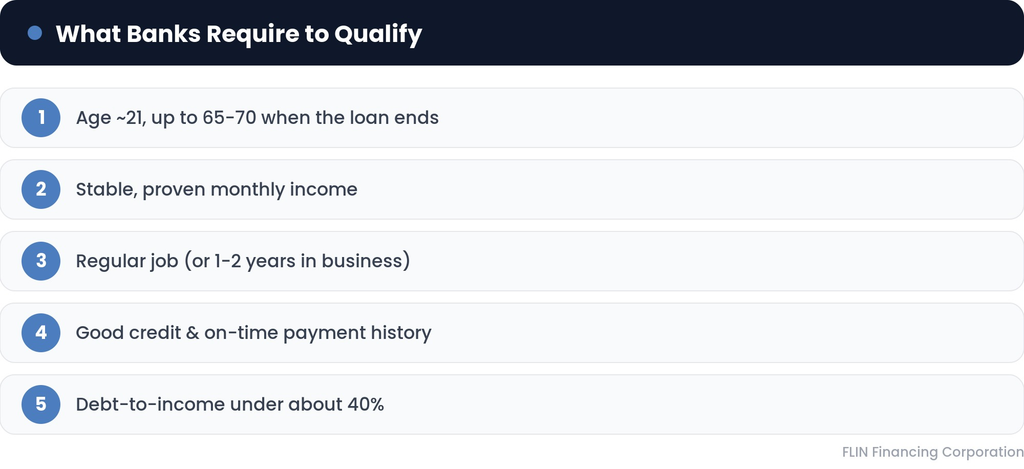
This is the main part of your question. Each bank is a little different, but the eligibility checks are mostly the same:
- Age. Usually 21 years old when you apply, and no more than about 65 to 70 when the loan ends.
- Stable income. You need proof of steady income. The minimum gross monthly income often starts at around 15,000 pesos if you have a credit history, and higher, around 25,000 to 30,000 pesos, if you do not.
- Employment or business length. Usually permanent or regular employment, or for the self-employed, a business running for one to two years.
- Good credit history. Banks check your credit record and payment history. A record of paying on time helps your application.
- A healthy debt-to-income ratio. Banks look at how much of your income already goes to debt. As a general rule, keeping your total monthly payments under about 40 percent of your income improves your chances.
Things to note, these criteria might be different depending on what bank that you take. Thus, you need to ask them clearly before applying.
What Documents Do You Need?
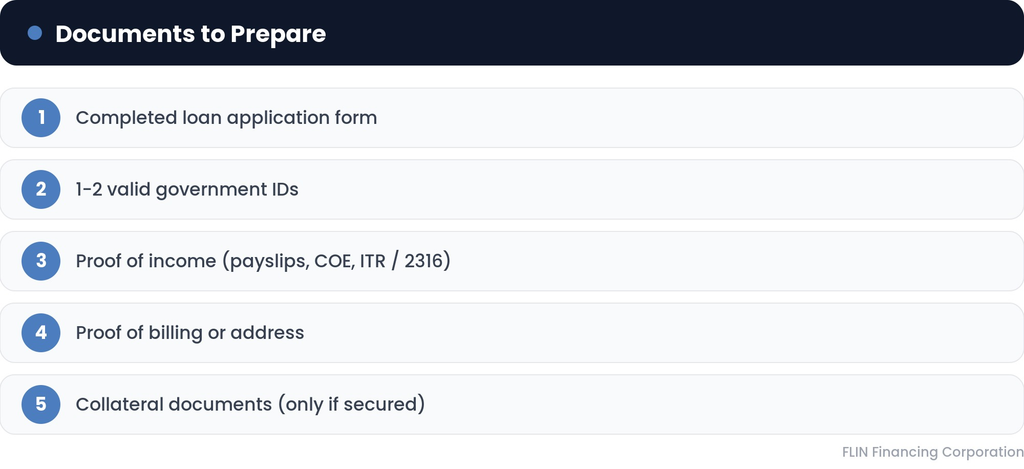
The paperwork is fairly standard. Based on the usual documentary requirements, prepare these before you apply:
- A completed loan application form from the bank.
- One or two valid government-issued IDs, such as a UMID, passport, or driver’s license.
- Proof of income. For employees, this is usually your latest one to three months of payslips, a Certificate of Employment and Compensation, and your Income Tax Return or BIR Form 2316. For the self-employed, it is your ITR, three to six months of bank statements, and business registration documents.
- Proof of billing or address, such as a recent utility bill.
- Collateral documents, only if you apply for a secured loan.
A useful tip: incomplete documents are one of the most common reasons applications get rejected, so gather everything first. And always be truthful, because misrepresenting your income or hiding existing debts can lead to rejection or legal trouble.
What Is the IDRP, and How Is It Different?
If your problem is specifically several credit cards, there is a route made for that. The Interbank Debt Relief Program, also called the Inter-bank Debt Restructuring Program, is run with the banks and the Credit Card Association of the Philippines. It lets you combine your credit card debts from different banks into one plan with a lower, standardized interest rate and a repayment term that can last for years. It is designed for people who are stuck on card debt. The trade-off is that you lose access to your cards while you repay.
How to Get Approved, Tips that You Need to Know
A bank consolidation loan is easiest to get when you need it least. Because banks require good credit and a stable income, the people who qualify most easily are those who are stretched but still paying on time. If you have already missed payments, your credit has dropped, or your current debts already take most of your income, a bank may reject you.
So there is a real problem with bank consolidation: the worse your debt situation is, the harder it is to qualify. If your credit is still good, a bank loan is a cheap and solid option, so start there. If you are past that point, you still have other options.
What if a Bank Turns You Down?
A rejection is not the end. When a new bank loan is not possible, you can still consolidate through a negotiated plan, where your existing debts are combined and restructured directly with your lenders, without you needing to qualify for new credit. This option works with the debt you already have instead of depending on a new loan approval, so it can work even if you are already behind.
How Do You Apply, and What Should You Watch For?
If you go with a bank, the steps are simple: compare the total cost and interest across a few lenders, not just the monthly payment, prepare complete documents, and make sure any lender you approach is properly licensed and regulated. Read the full terms before you sign, and never pay an advance fee to “release” a loan, because legitimate banks do not ask for that.
One note: this article is general information, not legal or financial advice. For your specific situation, it helps to speak with a financial or legal professional, and free legal help is available from the Public Attorney’s Office if you qualify.
When a Bank Loan Is Not the Answer
If a bank consolidation loan is out of reach, because your credit has dropped or your debts already take more than your income can handle, you are not stuck. It just means you need a different kind of consolidation. All debts are merged into new single loan that is easy-to-manage like picture below.
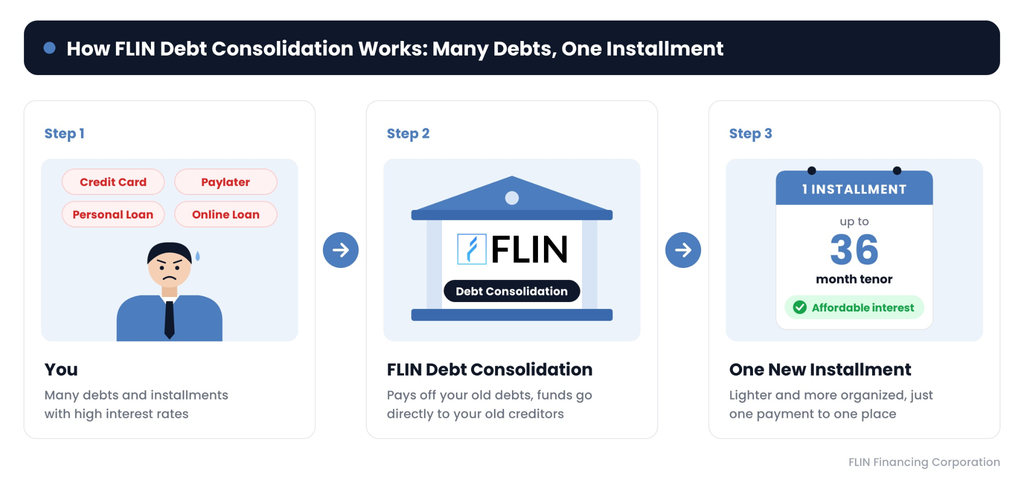
FLIN helps salaried Filipinos combine high-interest debts, online loans, credit cards, and buy-now-pay-later balances, into one more manageable monthly payment. Because it works with your existing debts, it can help even when a regular bank loan is not an option. A short, no-pressure consultation is enough to see what fits your situation. Bank consolidation is a good choice if you qualify, and if you do not, there is still a clear way to turn your many debts into one.
Your Debt-Free Life Start Here
Consult with us and get the best solution based on your financial condition
SEC Registered
SEC Registration number : 2026040247321-01