
Debt Consolidation
Where Can I Apply for Debt Consolidation in the Philippines?

So you have decided that combining your debts into one is the way forward. Smart move. The next question is the practical one: where do you actually go to make it happen? There are a few different places, and the right one depends on your situation, because “debt consolidation” can happen through a new loan or, in some cases, without taking a new loan at all.
💡 Highlights
- Debt consolidation in the Philippines can be done through a new loan or through a negotiated plan without new borrowing.
- Common places for a consolidation loan include banks, government funds like SSS and Pag-IBIG, and cooperatives.
- A balance transfer between credit cards is another way to consolidate card debt.
- Always confirm any lender is legitimate and properly authorized before applying.
- If you are already struggling to pay, taking another loan is not always the right answer.
- A debt resolution facilitator can arrange a consolidation plan by negotiating with your lenders, which is different from giving you a loan.
- The best route depends on whether you can still qualify for a loan, or your debts have grown past that point.
Where Can You Get a Debt Consolidation Loan?
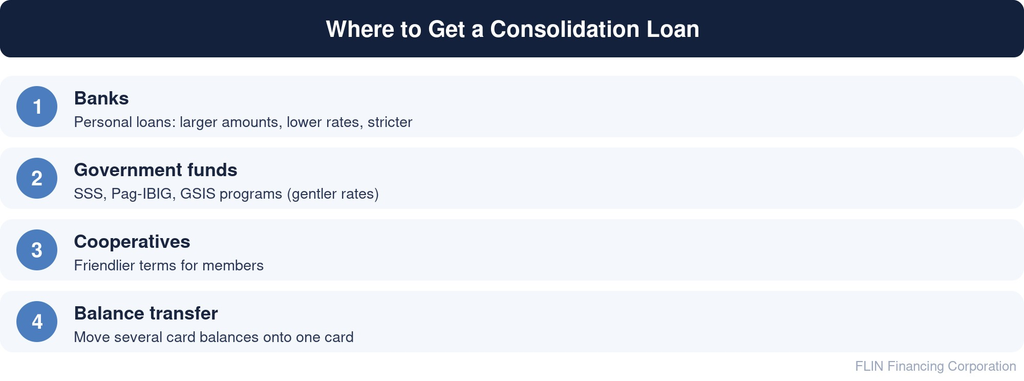
If you plan to consolidate by taking one new loan to pay off the rest, here are the usual places to look.
Banks
The most common route. Many banks offer personal loans that you can use to pay off your other debts, leaving you with one bank payment. These usually offer larger amounts and lower interest than app lenders, but they are stricter and require good documents and a decent credit standing.
Government funds
Some government agencies offer consolidation, restructuring, or penalty-condonation programs for their own eligible loan accounts.
For example, SSS currently offers a Conso Loan Program for eligible members with past-due SSS short-term member loans, allowing qualifying outstanding balances to be combined into one SSS Consolidation Loan.
Pag-IBIG and GSIS also have specific restructuring or remediation programs for eligible loan accounts. Availability, eligibility, and terms depend on the program and loan type.
Cooperatives
If you belong to a cooperative, it may offer a single loan to combine your debts, often with friendlier terms than banks for members.
Balance transfer
If your problem is mainly several credit cards, some banks let you move your balances onto one card, sometimes with a low or zero promotional interest rate for a period. This is a form of consolidation focused on card debt.
What if I Cannot Get a New Loan? Is There Another Way?
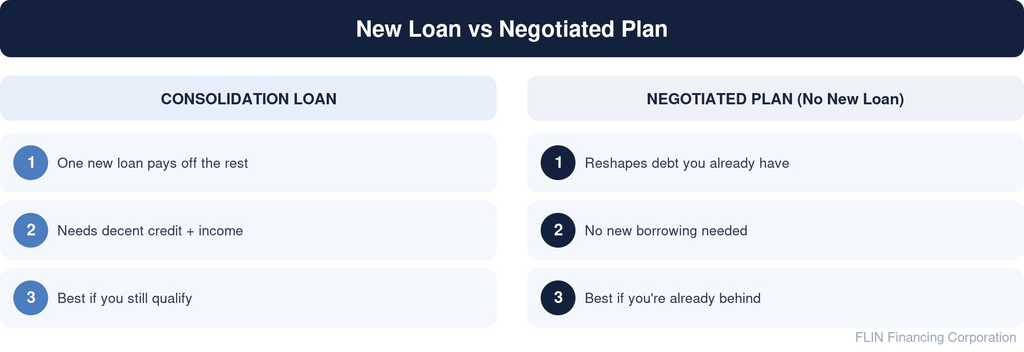
Yes, and this is the part many people do not know about. Consolidation does not always require taking a brand new loan. If you are already behind on payments or your credit standing makes a new loan hard to get, there is another route: a negotiated consolidation plan.
Instead of borrowing fresh money, your existing debts are brought together into one restructured repayment plan, arranged directly with your lenders. Penalties are often frozen, the term is stretched to something manageable, and you make one payment. This is especially useful for people who are struggling, because it does not depend on qualifying for more credit. It works with the debt you already have, not by piling on more.
How Do You Choose the Right Option?
It comes down to your situation. If you still have a steady income and a decent credit standing, a bank consolidation loan or a government-fund loan is often the cheapest, cleanest route, so start there.
If you are a member of a cooperative or have SSS or Pag-IBIG eligibility, compare those too, since their rates can be gentler. If your issue is purely credit cards, a balance transfer might do the job. And if you are already behind, or a new loan is out of reach, that is when a negotiated consolidation plan usually makes the most sense.
However, getting a solution from SSS or Pag-IBIG might be difficult due to its requirement. If you’re looking for a fast and trusted solution, FLIN is the best solution. We are a licensed debt consolidation service that can help you in solving the debt problems. Click below to get free consultation for your debt!
How Do You Make Sure the Lender Is Legitimate?
Wherever you apply, verify it first, because predatory lenders love to target people looking to consolidate. Before you sign anything, check that the lender is properly licensed. A legitimate lending or financing company must be registered with the SEC and hold a valid Certificate of Authority, and banks are supervised by the BSP.
Other quick safety rules: always get a clear written breakdown of the interest, fees, and total cost before agreeing. If anything is hidden or rushed, walk away.
Can FLIN Help With Debt Consolidation?
If you are struggling with multiple debt payments and are unsure which consolidation option may be suitable, FLIN can help eligible borrowers review their existing debts and explore their available options.
FLIN’s debt consolidation service is different from simply taking another loan. Depending on your financial situation, eligibility, and the debts involved, FLIN may help facilitate a more structured repayment arrangement for eligible debts.
Start with a free consultation to understand whether the service may be suitable for your situation.
For more information regarding debt consolidation, check below:
Your Debt-Free Life Start Here
Consult with us and get the best solution based on your financial condition