Debt Consolidation
If My Lender Is Shut Down or Unlicensed, Do I Still Have to Repay the Loan?
It sounds almost like good luck. Your lender gets shut down by the SEC, or you discover the app that lent you money was never licensed in the first place. Does that mean your debt just disappears? It is one of the most asked questions among Filipino borrowers today, and the honest answer is: it depends, and it is more complicated than the rumors suggest.
This guide breaks down what really happens to your loan when a lender is shut down or unlicensed, in plain language. One important note upfront: this is general information, not legal advice, and because the law here is genuinely unsettled in places, it is worth talking to a lawyer about your specific case.
💡 Highlights
- There are two very different situations: a lender licensed when you borrowed but shut down later, versus one that was never licensed at all.
- If your lender was licensed when you borrowed and lost its license later, you generally still owe the money, at least the principal.
- If the lender was never licensed, the law is genuinely divided, and even experts disagree on whether you must repay.
- Even the SEC has said borrowers are not obligated to pay unregistered lending platforms, but courts have sometimes still required returning the principal as cited here.
- Excessive, unconscionable interest can be struck down or slashed by courts no matter what.
- Do not assume “the lender is illegal, so I owe nothing.” That gamble can backfire.
- Get legal advice before you stop paying, and document everything.
First, Which Situation Are You In?
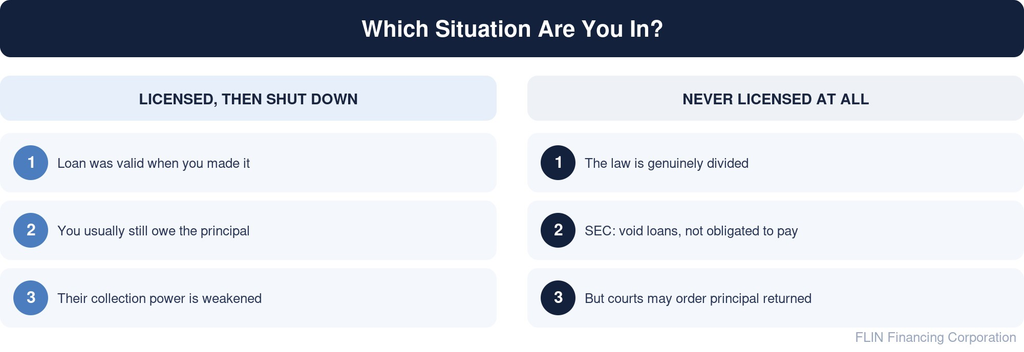
This is the key question, because the answer changes completely depending on it. There are two very different scenarios, and people often mix them up.
The first is when your lender was properly licensed at the time you borrowed, but later got shut down or had its license revoked. The second is when the lender never had a license at all, meaning it was operating illegally from the very start. These two lead to different answers, so let us take them one at a time.
If My Lender Was Licensed but Later Shut Down, Do I Still Pay?
In this case, the general answer is yes, you usually still owe the money, at least the principal you actually received.
The reason is simple. When you took the loan, it was a valid, legal agreement. A license being revoked later affects the lender’s future operations, not the deals it already made. So the debt you validly took on does not just vanish because the company was later closed. In practice, a shut-down lender often has its accounts transferred to another entity or handled through a wind-up process, and you may be asked to keep paying that party.
That said, two things shift in your favor. The lender’s power to aggressively collect or sue can be weakened once its authority is gone. And any interest that piled up after the revocation, or any interest that was unreasonably high to begin with, becomes very vulnerable to being reduced or thrown out by a court.
What if the Lender Was Never Licensed at All?
Here is where it gets genuinely complicated, and I want to be honest rather than give you false confidence. When a lender never had a Certificate of Authority, the law is actually divided, and even legal experts and different court decisions do not fully agree.
On one side, the SEC’s own public position has been that loans from unregistered lending platforms are void, and that borrowers are therefore not legally obligated to pay them. Courts have, in many cases, dismissed collection suits filed by unlicensed online lenders, reasoning that an illegal lender cannot ask the courts for help enforcing an illegal deal.
On the other side, a long-standing principle of Philippine contract law says you should not be unjustly enriched, meaning you should not get to keep money that was really lent to you just because the lender broke licensing rules. Under this view, even if the illegal interest and charges are void, you may still be required to return the principal, the actual amount you received.
So the truthful answer is that it is contested. Some borrowers have walked away owing nothing after courts dismissed the case. Others have been told to at least return the principal. Which way your situation goes can depend on the specific facts and the court, which is exactly why legal advice matters here.
What Happens to the Interest and Penalties?
This part is clearer, and it is good news. No matter which situation you are in, excessive and unconscionable interest can be struck down. Philippine courts have repeatedly ruled that punishing interest rates, the kind many illegal apps charge, are void for being unreasonable.
Philippine courts may reduce or strike down interest and penalties that are found to be unconscionable. The applicable rate and period depend on the facts and legal circumstances of the case. In some cases, courts have applied the 6% legal interest rate, but this should not be treated as an automatic replacement rate for every loan.
Can They Still Chase Me or Have Me Arrested?
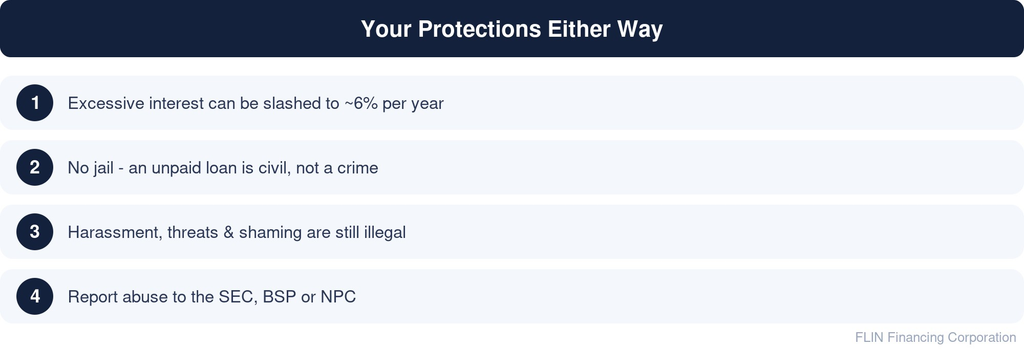
Two reassurances here. First, a shut-down or unlicensed lender is in a much weaker position to collect. It has lost the legal high ground, and if it never had a license, it may not be able to successfully sue you at all.
Second, Failure to repay an ordinary debt does not, by itself, result in imprisonment for debt. The 1987 Philippine Constitution provides that no person shall be imprisoned for debt, as cited from here.
So Should I Just Stop Paying?
Be careful here, because this is where people get burned. It is tempting to hear “the lender is illegal” and simply stop paying, assuming you are in the clear. But given how divided the law actually is, that can be a risky gamble.
If it turns out your debt is still considered valid, especially the principal, stopping payment without a plan could expose you to a civil case or hurt your credit record. So the smart move is not to assume, but to find out. Confirm the lender’s real status, get advice on your specific situation, and act from facts rather than hope.
What Should You Do?
Here is a calm, practical checklist.
Confirm the lender’s status
Check whether it is truly unlicensed or revoked by verifying against the SEC’s official lists.
Document everything
Save your loan records, proof of what you actually received, every payment you made, and any harassment.
Do not pay into random personal accounts
If a “collector” from a shut-down lender demands payment to a personal GCash or bank account, verify first, because scammers exploit these situations.
Get legal advice
Because the unlicensed-lender question is genuinely unsettled, a lawyer can tell you where your specific case likely stands. Free legal help is available from the Public Attorney’s Office for those who qualify.
To repeat the important disclaimer: this article is general information, not legal advice. The law on unlicensed lenders is contested, so please confirm your situation with a professional before making a decision.
Getting Clear on What You Actually Owe
Situations like these get messy fast, especially when you have several debts, some from legitimate lenders and some from shady ones, and you genuinely cannot tell what you truly owe anymore. Sorting out which debts are valid, which charges are illegal, and what a fair repayment actually looks like is hard to do alone, and honestly, it is exhausting to carry.
Instead of the endless forms, long queues, and strict requirements you would face at a bank, FLIN takes a lighter, more human approach: it looks at your full situation, helps separate the debts you genuinely owe from the ones treating you unlawfully, and works to pull your real debts together into one manageable payment that fits your life. One plan, one payment, far less stress. A short, no-pressure chat is enough to start making sense of it all. You have been dealing with the confusion and the pressure long enough. Let someone help you turn it into something simple.
Read more about tips in handling loan below:
Your Debt-Free Life Start Here
Consult with us and get the best solution based on your financial condition